You’ve rehearsed it in the car twice. And every version in your head ends with him going quiet, or saying something kind that means nothing, or the temperature dropping for two days.
So you don’t have it, and the not-having becomes its own weight.
This is practical observation rather than research findings, and I’ll say where that matters.
The fear is usually about structure, not the topic
People assume these conversations go badly because the subject is frightening. Usually it’s the shape they arrive in.
Most future conversations are launched as an examination — a question about his intentions, delivered after a long silence, at a moment of high stakes. That structure produces a defensive answer from almost anyone, regardless of what they actually want.
Key takeaway
A question about his intentions asks him to commit. A statement about your own hopes asks him to respond. The second gets far better information, and costs him nothing to answer honestly.
Four things that change how it lands
Go first. Say what you want before asking what he wants. I’ve been thinking I’d like to live with someone in the next couple of years. Now it’s a subject rather than an interrogation.
Pick an ordinary moment. Not after sex, not at the end of a night out, not after a disagreement. A Tuesday walk works because it’s unremarkable, and unremarkable is the whole point.
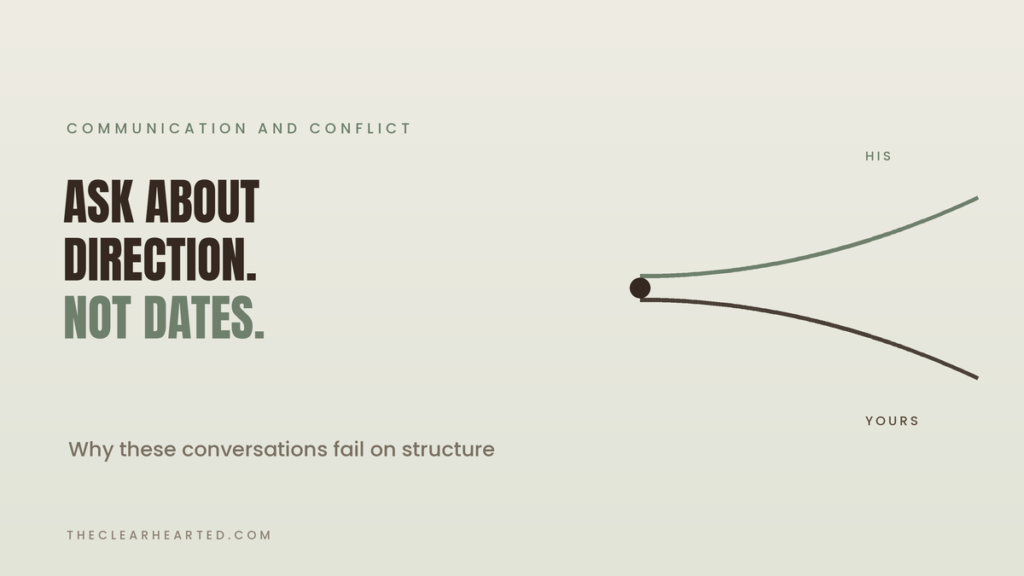
Ask about direction, not dates. “Do you see yourself wanting that at some point?” is answerable. “When are we moving in together?” requires a commitment he may not be able to make honestly, and pressure produces reassurance rather than truth.
Keep it short and let it sit. Two sentences, then silence. The silence will feel long. People fill silences with more truth than they put into answers.
Wording that works
- I don’t need an answer today. I’d just like to know we want roughly the same shape of thing.
- Can I tell you what I picture? And then you tell me if it’s anywhere near yours.
- Where do you think this is going? I’ll go first if it’s easier.
- I’m not asking you to decide anything. I’m asking whether it’s a direction you’d want.
Notice how much work “I’m not asking you to decide” does. Much of the panic in these conversations is someone believing they’re being asked to sign something.
What to do next
Write your two sentences down before you say them. Not to memorise — to find out whether you actually know what you want. A surprising number of people discover at this point that they’ve been waiting for him to define something they haven’t defined themselves.
Reading the answer
A real answer. Even a hesitant or partial one. I think so, but not for a year or two is a real answer and you can work with it.
A clear no. Painful and useful. You now know, months or years earlier than you would have.
The warm non-answer. The one to watch. Affectionate, reassuring, and containing no information — I love what we have, why do we need to plan it? It feels like a yes and functions like a no.
How to spot a non-answer
Afterwards, try to state what he said in one sentence. If you can only remember how the conversation felt, you received warmth rather than an answer. Notice that before you spend another six months on it.
If it happens, ask once more and plainly. Not as a confrontation — as a clarification. Sorry, I’m still not sure what you meant. Do you want that eventually or not really?
If it goes badly
Some people shut down at the first mention of anything long-term. That’s usually flooding rather than refusal, and the response is a pause with a return, not more pressure — see what to do when he shuts down completely.
What’s worth taking seriously is a different reaction: when the conversation becomes about you for having raised it. That you’re pushing, moving fast, making it a bigger deal than it is. That’s a specific move, and what to do when he says you’re “too much” covers it.
The thing nobody says
Asking early doesn’t scare off someone who wanted the same thing.
That fear is doing enormous work in this decision, and it’s worth examining rather than obeying. If the conversation ends things, it ended something that was going to end. You’ve bought back time, which is the only resource in this that you can’t get more of.
Clearhearted publishes general educational content about relationships. It is not therapy, counselling, or medical advice, and it cannot account for your specific situation. See our Disclaimer.



Conversation
Comments are closed.