It lands somewhere behind the ribs. Partly because it’s a judgement on your whole self rather than on anything you did, and partly because some part of you has been braced for it.
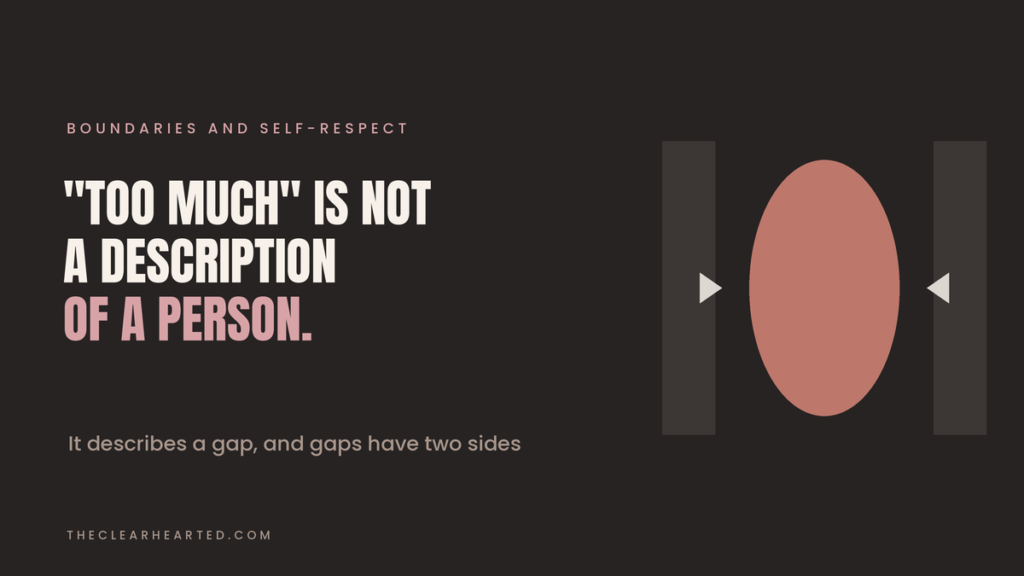
Before anything else: “too much” is not a description of a person. It’s a description of a gap between two people, and gaps have two sides.
This article is observation rather than research, and I’ll be careful not to tell you what your particular situation is — that isn’t something an article can know.
What the phrase does
Notice its shape. It doesn’t name a behaviour, a moment, or a request. It names a quantity of you.
That’s why there’s no way to answer it. If he’d said “I found that conversation overwhelming,” you’d have something to discuss. “You’re too much” gives you nothing to work with except the suggestion that you should be smaller.
Key takeaway
A complaint you can act on names a moment. A verdict you can’t act on names your character. The difference tells you a lot about what the sentence was for.
The two versions
Version one: a real mismatch, badly phrased. He needs more solitude than you do. He processes slowly and you process out loud. He finds high emotional intensity genuinely difficult, not as a criticism of you but as a fact about him.
People are bad at articulating this. “Too much” is what comes out when someone means “I can’t meet you at this level and I feel bad about it.”
Version two: a conversation-ender. You raised something. Rather than address it, he turned the subject to your intensity in raising it. Now you’re defending your temperament and the original thing has vanished.
This isn’t always deliberate. Someone flooded by conflict may reach for whatever ends it fastest. But whether or not it’s intended, the effect is the same: the thing you raised is gone, and you’re apologising.
How to tell which one you’re in
Ask what happened to the original subject. In version one, it comes back later — he returns to it once he’s steadier. In version two, it never comes back, and the pattern repeats: every time you raise something, the conversation becomes about how you raised it.
One instance tells you nothing. Three tells you the shape.
What to say in the moment
The most useful response is a question, because it converts a verdict back into something specific.
Too much of what, specifically?
Calm, not combative. It’s genuinely hard to deflect. Someone describing a real mismatch will usually be able to answer — I need more quiet than you do, I can’t do intense conversations at night. Those are workable. Two people can build around them.
Someone using the phrase to end a conversation typically can’t answer, or answers with more of the same generality. That absence of specifics is itself the information.
Other things worth saying:
- I’m happy to talk about how I said it. I’d like to come back to what I said.
- That sounds like it’s about who I am rather than what happened. Can we stay with what happened?
- I don’t think I’m too much. I think we might want different amounts of some things, which is worth talking about honestly.
What to do next
Next time it happens, ask the question and then track one thing: whether the original subject ever gets discussed. Not that night — within the week. That single observation separates the two versions more reliably than anything else.
Why becoming smaller doesn’t work
The instinct is to dial yourself down. Feel less, ask less, need less, and see whether the relationship gets easier.
It does get easier, which is the trap. The friction was coming from the parts of you that wanted things, so removing them removes the friction.
What you’re left with is a relationship that works on the condition that you’re not fully in it. That arrangement can last years, and it’s very hard to explain to anyone from the outside, because nothing is wrong.
Being liked for a reduced version of yourself is not the same as being liked.
The honest complication
There is a version of this worth taking on board rather than defending against.
If several people across different relationships have said something similar, and if the specific thing named is consistent — that conversations escalate quickly, that reassurance doesn’t hold, that disagreements become large — that’s a pattern worth understanding rather than dismissing. Not because you’re too much, but because patterns tend to have histories, and understanding yours changes what you can do with it. A good therapist is far better placed to help with that than any article.
That’s a different thing from one partner using a phrase to avoid a subject. Both exist. Only you can tell which describes your situation, and the difference is worth being honest with yourself about.
And if raising anything reliably becomes a conversation about you rather than the issue, what to say when he gets defensive covers that mechanism directly.
If this is your situation
If you are regularly told that your reactions are the problem, that events didn’t happen the way you remember, or that you’re the reason every conversation goes wrong, that is worth talking through with a professional. Please contact a domestic violence support service in your country if you feel unsafe. If you are in immediate danger, contact your local emergency services.
Clearhearted publishes general educational content about relationships. It is not therapy, counselling, or medical advice, and it cannot account for your specific situation. See our Disclaimer.