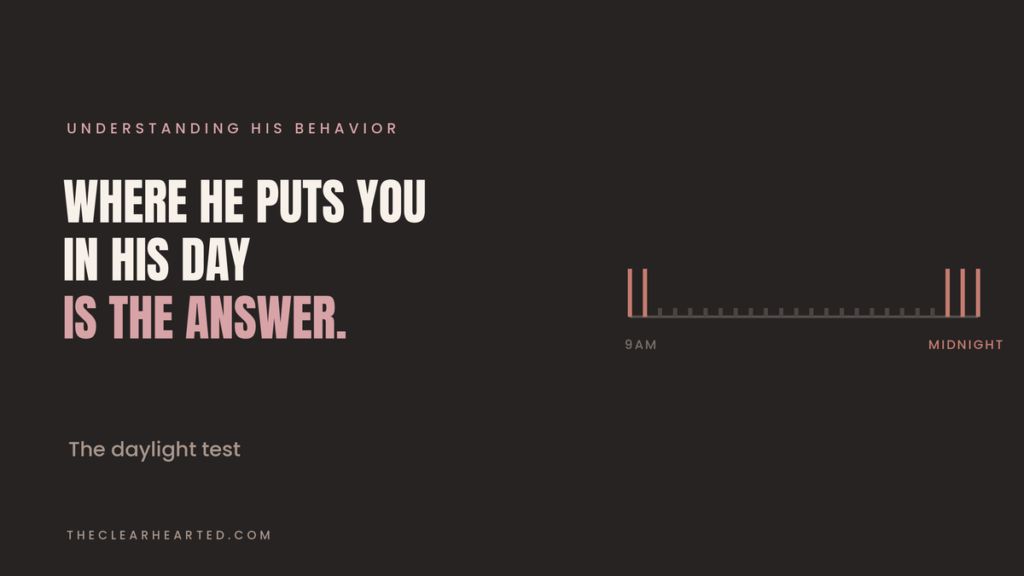
The messages are good. Warm, funny, sometimes long. They arrive at half past eleven, and almost never before nine.
You’ve noticed. You’ve also decided not to make it a thing, which is how six weeks pass.
This is observation rather than research, and I’ll say where that matters.
Why timing carries so much information
Most texting signals are noisy. Reply speed means little, message length means little, emoji use means nothing at all.
Timing is different, because it isn’t random. Where someone puts you in their day reflects where you sit in their life, and it’s one of the few things that’s hard to fake over weeks.
Key takeaway
A single late message means nothing. A consistent boundary at nine o’clock — nothing before, everything after — is a shape, and shapes are chosen even when nobody chose them deliberately.
The likely explanations
His day is genuinely full. Some jobs make daytime contact impossible. The most benign version, and it’s checkable — does he mention his day when he surfaces, or does he arrive with no context at all?
You’re the wind-down, not the day. He thinks of you when everything else is finished. That isn’t nothing, but it isn’t the same as being part of his life.
He’s keeping it low-commitment. Daytime messages create a thread, a back-and-forth, a relationship with texture. Late-night ones can be self-contained and require nothing the next morning.
It’s mostly about the physical. Worth naming plainly. If the pattern is late contact plus meeting only at night plus no daytime plans, that’s a consistent picture rather than three coincidences.
His daytime isn’t free. The least likely and the one worth not pretending is unthinkable. Late hours are the hours least likely to be observed.
The daylight test
You don’t need a confession. You need one piece of clean data, and there’s a simple way to get it.
Suggest something that happens in daylight. A coffee on Saturday, a walk on Sunday morning, lunch on a weekday. Nothing romantic, nothing loaded — just an ordinary daytime hour.
How to read the result
He says yes and shows up: the pattern was scheduling, not intent. He declines but proposes a different daytime thing: also fine. He declines and offers only evenings, repeatedly, with warmth and no alternative: that’s your answer, and it took two weeks rather than six months.
Daylight is the test because it costs something. Evenings can be spontaneous and deniable. A Saturday morning is a decision.
Or just ask
Faster, and it costs one uncomfortable minute.
I’ve noticed we mostly talk late. I’d like to see you in normal hours too — is that something you want?
Direct, unaccusing, and hard to answer without revealing something. Watch particularly for the warm non-answer: enthusiasm about how much he enjoys talking to you, with no proposal attached. That’s a no in a pleasant coat.
What to do next
Scroll back three weeks and note the time of every message he initiated. Not replies — the ones he started. The distribution will tell you more in four minutes than another month of wondering.
What not to do
Don’t start matching his hours. Going quiet until midnight to make a point turns it into a contest, and contests obscure the information you actually wanted.
Don’t accept “I’m just busy” more than twice. It’s often true. It’s also the easiest available sentence, and the daylight test settles it either way.
Don’t treat the quality of the messages as evidence. Late messages are frequently the best ones — unhurried, more open, more honest. That’s a feature of the hour, not a measure of where you stand.
Why this one is hard to walk away from
Because the connection in those messages is usually real. You’re not imagining it.
What makes it costly is that it’s enough to occupy the space a relationship would take while never becoming one. It’s the same structure as constant texting with no plans, with a clock attached.
And if the waiting between messages is the part that’s actually hard, that’s covered in what to do when he takes hours to reply.
Clearhearted publishes general educational content about relationships. It is not therapy, counselling, or medical advice, and it cannot account for your specific situation. See our Disclaimer.