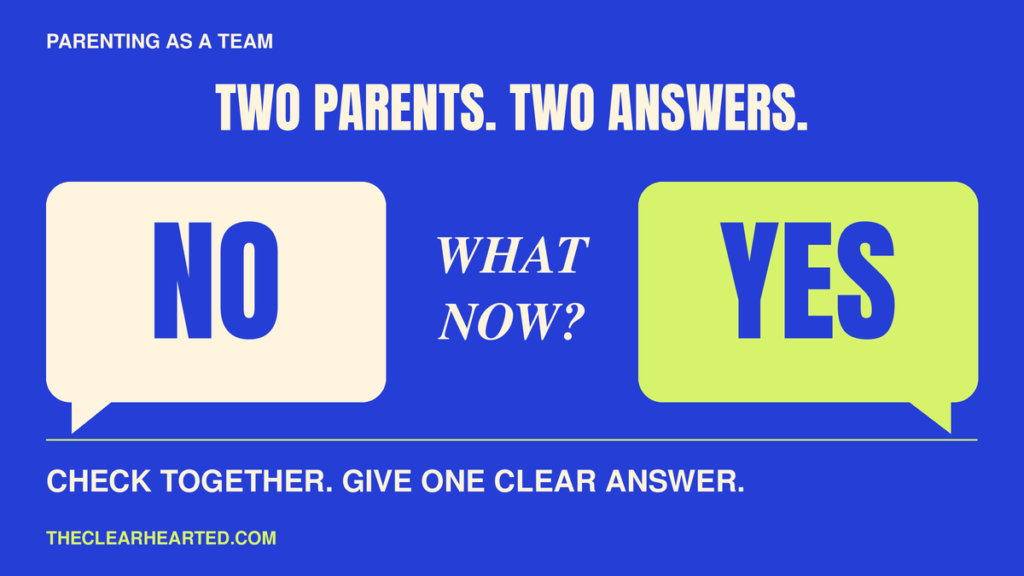
You said the tablet was finished for the evening. A few minutes later, your child walks past with it. “Dad said I could.” Now you have a second decision to make, this time with two people watching.
When your child asks the other parent after hearing no, pause before turning it into a lesson about who is in charge. First find out what each adult knew. Then give your child a clear answer together, or explain that you need a moment to decide. You can address the way the second request happened without making your child responsible for the disagreement between you.
The goal is a fair process for asking, checking, and occasionally reconsidering. The first answer should not become untouchable simply because it came first. Equally, a child should not have to guess which parent will overrule the other today.
Start with the missing information
There are several versions of this moment. Dad may not know you already answered. Your child may have asked a different question: you said no to a game, while Dad agreed to a school message. Or he may know your answer and disagree with it.
Ask briefly, away from your child if possible: “Did you know I’d already said screens were finished?” The answer helps you identify whether you need a simple correction or a real parenting conversation.
Avoid opening with “You always make me the bad guy.” That feeling may deserve discussion later, but it will not tell you what happened tonight. Begin with the decision in front of you, then return to any recurring pattern privately.
The American Academy of Pediatrics recommends clear, consistent limits alongside listening to children. That combination is useful here: explain the process, while leaving room to hear information neither parent had.
Give your child a temporary answer without blaming them
Try: “We gave you two answers. Put the tablet here while we check, and we’ll tell you the plan.”
This takes responsibility for the confusing result. It also avoids letting the more appealing answer become final before the adults have spoken. Keep the pause proportionate; do not leave a child waiting indefinitely for an ordinary decision.
If you cannot speak immediately, give a concrete next step: “For now, screens are paused. We’ll talk after dinner and answer before story time.” For a request that cannot wait, such as a ride about to leave, make the immediate practical decision and explain it simply.
Do not make your child deliver messages between you: “Go tell your dad I already said no.” Speak to him yourself. That removes the child’s job of translating two frustrated adults to each other.

Resolve the particular request before debating your whole parenting style
Ask three questions together: What was requested? What information did each of us have? What answer makes sense now?
Sometimes the answer remains no. Sometimes new information changes it. Perhaps you thought your child wanted another game, but they need to send a classmate a homework photo. You can revise the decision openly: “I misunderstood the request. You can send the photo, and then the tablet goes away.”
That is different from quietly allowing another hour because a second adult was asked. You are explaining why the decision changed, rather than making persistence the only visible reason.
If you still disagree, choose a short-term arrangement for this occasion and schedule the larger conversation. Our guide to being contradicted in front of the kids covers the wider partnership issue. This situation also needs a process your child can use next time.
Teach a better way to ask for reconsideration
Children can ask again without concealing the earlier answer. Give them the words: “Mom said no. Can we explain why I wanted it and check together?” Or, for an older child, “Dad said this won’t work. Is there an alternative we could discuss?”
Tell them what to expect. A review means adults will listen; it does not guarantee the answer changes. You might say, “You can tell us if we missed something. Asking a different adult without mentioning the first answer makes it harder to sort out.”
Keep the explanation about the action, not their character. Avoid labels such as sneaky or manipulative for a child checking whether another adult will agree. If they knowingly hid the earlier answer, name that fact and practice a more honest request.
For a young child, shorten it: “Tell Dad what Mom said first.” Then the adults need to do their part by checking with each other. A rule only for the child leaves the household with the same communication gap.
Make four small agreements between the adults
Ask whether the other parent has already answered
Before agreeing to a request that may affect an established rule, ask, “Have you already spoken to Mom?” This does not need to become an interrogation about every snack or game.
Use it where contradictory answers have been creating trouble: screens, spending, staying up, going out, or inviting friends. Start with the recurring issue rather than trying to coordinate every ordinary choice.
Check directly when the answers differ
“Let me check with Dad” is a complete response. A quick message or private minute may be enough. Do not require the child to prove one parent’s position to the other.
If you are apart, agree on a sensible temporary approach for nonurgent requests. Avoid promising an answer before you know whether the other parent is available. Tell the child when you can realistically return to it.
Explain exceptions when they are real exceptions
A later bedtime for a relative’s visit can coexist with an ordinary bedtime. Explain what makes this occasion different and when the usual routine resumes.
Otherwise, children may see only that one parent says no and the other makes it disappear. A shared sentence helps: “We both agreed tonight can be different because tomorrow is a holiday.” Make that sentence true before saying it.
Review the rule when nobody is waiting for permission
An argument at the tablet charger is a poor time to decide your whole approach to screen use. Arrange a separate discussion about what the rule is, why it exists, and whether it still fits your child’s age and circumstances.
Both adults need genuine input. Agreement cannot mean one parent writes every rule and the other is expected to enforce it forever. You can reconsider an impractical limit while still asking that changes are discussed clearly.
A worked example: the sleepover request
Imagine your eleven-year-old asks to stay at a friend’s house. You say no because you believe there will be no adult home. They later ask Dad, who knows the friend’s parent is actually staying in that evening, and he says yes.
Begin by checking the information. If an adult will be home and you have other questions, discuss those rather than defending the original no just to preserve authority. You might decide the sleepover is fine after speaking to the host parent.
Then explain both parts to your child: “We learned something different about who will be home, so we’re reconsidering. Next time, tell Dad you’ve already asked me and what I was worried about.”
If the answer stays no for another reason, name it: “We still need to know the family better before an overnight visit. You can have an afternoon together instead.” Offer an alternative only if you can actually arrange it.
Dad can own his part too: “I should have checked why Mom said no before I answered.” That avoids making the child the sole cause of an adult communication problem. Nobody needs to be publicly declared the unreasonable parent for the family to reach one usable answer.

When the child says you are the mean parent
Hearing “Dad lets me” can sting, especially if you already carry most of the routines. You do not have to persuade your child that you are the fun one. Respond to the request: “I understand you prefer his answer. We’re going to check it together.”
Later, talk to your spouse about the division of responsibility. Does one parent regularly manage homework and sleep while the other arrives for treats and exceptions? That is a partnership question to solve privately, not a comparison to explain to your child.
For a specific recurring evening problem, our guide to sharing bedtime when a child only wants Mom explores how both parents can participate in the routine, rather than leaving one to enforce it alone.
A shared approach must still leave room to protect a child
Checking with the other parent does not mean supporting an unsafe or degrading response. Stop immediate harm and attend to the child’s needs. Discuss the adult disagreement afterward when that is safe.
Children’s Hospital Los Angeles recommends keeping children out of parental disputes. Apply that without pretending adults are never wrong. You can say, “I spoke too sharply. Let’s start again,” while keeping an appropriate limit.
If one parent routinely threatens, humiliates, or frightens the child, seek qualified support. A permission-checking system is not a solution for intimidation.
Short FAQ
Should the first no always stand?
No. Hear relevant information and consider whether the decision was fair. Explain a change so your child understands the reason, rather than learning only that another adult gave a different answer.
Should we punish our child for asking Dad?
First clarify what happened and teach the process you expect. Asking a question is different from knowingly hiding an earlier answer. Address specific behavior proportionately, without blame for the adults’ conflicting decisions.
What if my child asks the other parent every time?
Choose one recurring situation, make the adult checking process consistent, and teach a clear way to request review. If the parents keep providing incompatible answers, work on that agreement as well.
Your child needs an answer they can understand and adults who will speak to each other. One honest pause, one checked decision, and one clear explanation are useful progress for tonight.
Clearhearted publishes general educational content about relationships and parenting. It is not therapy or individual professional advice. See our Disclaimer.