
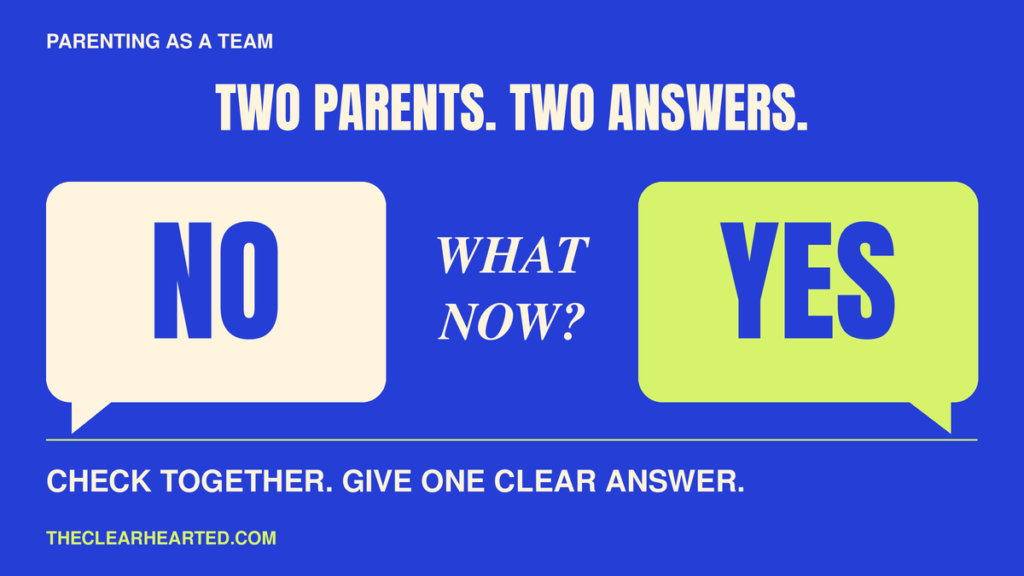
You answered. Your spouse answered differently.
The child asks whether they can stay up later. You say no because tomorrow starts early. Your spouse says, “It’s fine—let them.” Suddenly the bedtime question has become a conversation about which adult’s answer counts.
Parents will not agree on every limit. Children can handle seeing adults think differently. What is difficult is getting pulled into a contest between the people who care for them, especially when the adults begin arguing in front of them.
You can handle this without pretending the disagreement didn’t happen or insisting that both parents always give identical answers.
In the moment, take your child out of the middle
If the issue can wait, try: “We gave you two different answers. That’s on us. We’ll talk for a moment and let you know.” Then discuss it away from your child’s hearing. Don’t ask the child to decide which parent was fairer or recruit them to explain your case.
If you need an immediate answer, choose a calm temporary rule: “Tonight we will stick with the usual bedtime, and we’ll talk about tomorrow together.” A decision for one evening is easier to make than a verdict on each other’s parenting.
Safety is different. If a decision puts a child at risk, respond to the risk immediately; you do not need to stay silent for the appearance of agreement.
Talk about the decision, then the way it happened
When the child is elsewhere, separate two subjects. You might genuinely disagree about bedtime. You may also need to discuss how each of you responds after the other has already given an answer.
“I know we see bedtime differently. When you changed my answer while she was standing there, I felt we were asking her to manage our disagreement. Can we choose a way to pause next time and talk privately?”
Then hear the other parent’s reasoning. Maybe they had information you didn’t; maybe they made a quick call they now see differently. The aim is an agreed process for the next time, not forcing a confession of bad parenting.
The American Academy of Pediatrics advises parents to discuss concerns about a child’s other parent in private and avoid fighting where children can hear. The underlying point is useful in the same household, too: keep children out of adult disputes. See its guidance on children and parental conflict.
Agree on three repeat situations
Most families do not need a policy for every choice. Start with the disagreements that recur: bedtime, screen time, consequences, or asking one parent after the other says no.
- What is the default answer until both parents have talked?
- Which decisions can either parent make on their own?
- What phrase will you use when you need a private minute?
A plan might be: “For bedtime changes, either of us can say, ‘We’ll check and get back to you.’” That gives you a usable sentence at the exact moment you tend to clash.
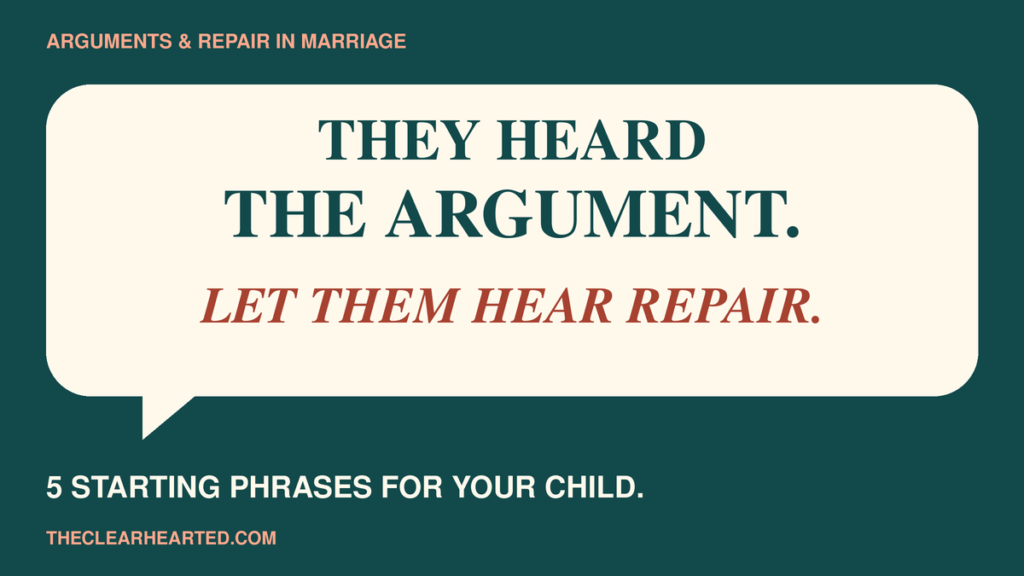
If your child saw the argument
You can repair the moment without telling them all the details: “We disagreed about bedtime and argued. That was our job to sort out, not yours. We’re working on a better way to talk about it.” Follow with the rule for tonight.
One disagreement is not the story of your parenting. What matters is whether you and your spouse can recognize the pattern, keep your child out of the middle, and try a clearer response next time.
Clearhearted publishes general educational content about relationships and parenting. It is not therapy, counselling, medical, or legal advice and cannot account for your specific situation. See our Disclaimer.

Conversation
Comments are closed.