You and your partner have lowered your voices. The argument is over, or at least paused. Your child is back with their toys, and you are wondering whether bringing it up will only make the evening worse.
If you are unsure what to say after arguing in front of your child, begin with what they actually witnessed. Acknowledge it, take responsibility for your behavior, explain that it was not their fault, and leave room for questions. You do not have to finish every adult disagreement before offering that reassurance.
The conversation can be brief. Its purpose is to give your child an honest explanation and a way to ask about what worried them. Five starting sentences below can help, followed by examples for different ages and for a disagreement that is still unresolved.
First, make sure you can offer a calm conversation
If voices are still rising, attend to the immediate situation before trying to explain it. Give your child appropriate supervision and space away from the dispute. Return to the adult issue when it can be discussed safely and privately.
Once you are calmer, choose an ordinary moment when your child can respond. You do not need to summon them to a formal family meeting. Sitting beside them for a few minutes may be enough. Avoid starting a complicated discussion while you are rushing out of the house.
Children’s Hospital Los Angeles recommends acknowledging inappropriate behavior and providing direct reassurance after an argument gets out of hand. Let the check-in match what happened. A quiet difference of opinion and an exchange involving threats require very different responses.
If there was intimidation, physical aggression, or fear for anyone’s safety, prioritize safety and outside support. Do not describe a frightening incident as harmless just to make the conversation easier.
Five things to say after an argument they overheard
1. “You heard us raising our voices earlier.”
Begin with something concrete and true. If the child saw a door slammed, name that instead of using a vague phrase such as “Things got a little silly.” You can describe the behavior without repeating hurtful words.
Then allow a pause. Your child may correct your account: “I heard it from my room,” or “I thought you were shouting at me.” That tells you which explanation they need. You do not have to give a complete account before they can speak.
Avoid testing them with “You didn’t hear us, did you?” That invites the answer you would prefer. Try, “Did you hear anything you want to ask about?” If they do not want to talk now, you can leave the invitation open.
2. “I was upset, and I shouldn’t have shouted.”
Own your action without adding a justification that hands responsibility to someone else. “I shouted because your dad wouldn’t listen” turns an apology into another version of the argument.
You can still explain that adults have strong feelings: “I felt frustrated, and I needed to handle that differently.” That separates the feeling from the choice of behavior. It does not require you to claim responsibility for something the other parent did.
If you remained calm, you do not have to invent a matching mistake. Say what is yours to say: “You heard shouting. I know that was upsetting, and I want to check what you need.” Each adult is responsible for an honest account of their own conduct.
3. “You didn’t cause the shouting, and you don’t have to fix it.”
This is especially useful if the argument mentioned homework, childcare, bedtime, or something the child did. They may hear their name and conclude that the adults’ behavior was their responsibility.
Distinguish an everyday issue from the way adults handled it: “We were discussing the school pickup. Arranging that is our job. It wasn’t your fault that we raised our voices.” You can address a child’s separate behavior later without making it the reason adults lost control.
KidsHealth’s explanation of parents arguing directly addresses children’s possible self-blame and emphasizes that they do not have the job of refereeing. Your words can make that responsibility clear before a child tries to carry it.
4. “We’re going to handle the next conversation differently.”
Follow this with one realistic action: “We’re taking a break now and will talk privately after dinner.” Or, “If our voices rise, we’re going to stop and return when we’re calmer.”
Do not promise that adults will never disagree again. Do not promise a peaceful home while leaving frightening behavior unaddressed. Name a step you can actually take and then follow through.
The American Academy of Pediatrics advises parents to apologize for mistakes and explain how they will respond differently. A modest change your child can observe gives the apology more substance than a sweeping promise made while everyone is distressed.
5. “What was that like for you? Is there anything you want to ask?”
Listen for the actual concern. A child might worry about someone leaving, feel annoyed that the shouting interrupted a game, or ask why one parent cried. Those are different questions.
Answer what you know, with only the adult detail they need. “We disagreed about a plan” may be enough. If you do not know the answer, say so without making the child manage your uncertainty: “We haven’t decided that yet. The adults are working on it, and we’ll explain changes that affect you.”
Accept a short answer or no answer. Reassurance is an offer, not an interview they must complete. You can say, “You can ask me later too,” and return to an ordinary activity together.
Put the sentences together without making a speech
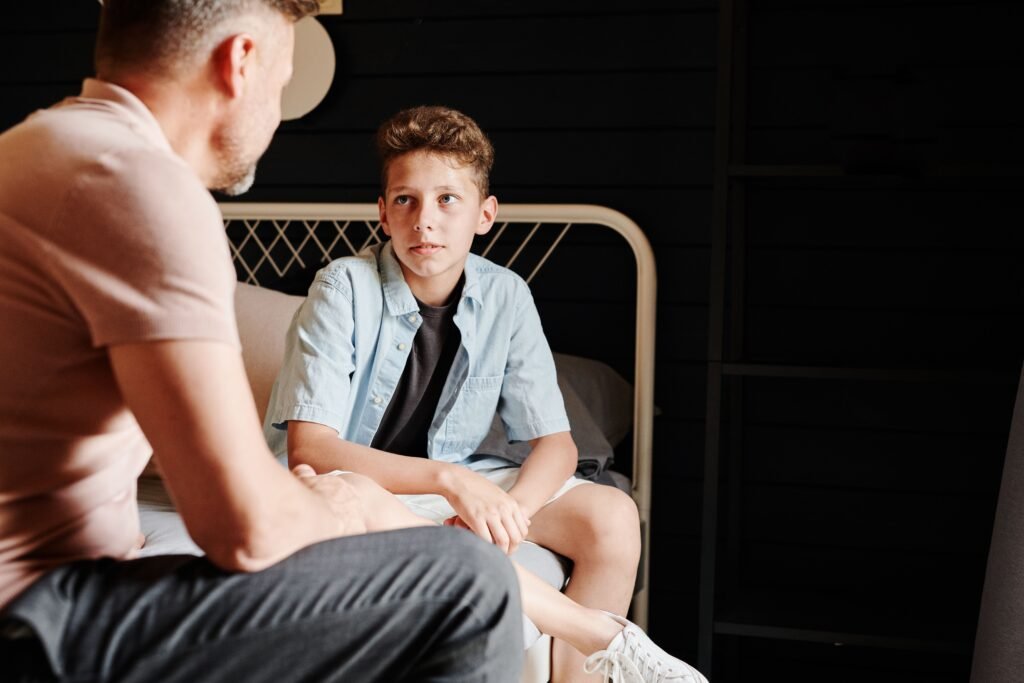
Imagine your child heard raised voices over a missed pickup. A brief check-in could sound like this:
“You heard me shouting about the pickup. I was frustrated, and I should have spoken differently. Sorting out rides is an adult job. You didn’t cause the shouting, and you don’t need to fix it. We’re going to talk privately later. Did anything you heard worry you?”
Suppose your child answers, “I thought Dad was leaving.” Respond to that fear directly. If he stepped outside to cool down and you know he is returning, say that. Do not make a wider promise about the marriage unless it is something you can honestly say.
If the child then asks for a snack, let the conversation end. They do not need to keep demonstrating that they understood. You can keep your invitation open while returning to the rhythm of the evening.
Adjust the conversation to your child’s understanding
For a young child, use short, concrete language: “That was loud. I’m sorry I shouted. You didn’t make me shout. I’m here.” Offer comfort they welcome; do not require a hug as evidence that the apology worked.
A school-age child may want a clearer explanation. “We disagreed about who was collecting you. We should have checked the plan and spoken calmly.” Let their questions guide how much more you say.
A teenager may notice a repeated pattern or challenge a promise. Listen if they say, “You said that last time.” You can answer, “You’re right. An apology doesn’t change what happened. I’m taking this step now.” Keep the focus on action rather than persuading them to reassure you.
These are language examples, not rules about what every child of a certain age will need. Consider their communication style, what they witnessed, and whether they want to talk now or later.
What to say after arguing in front of your child when you are still upset
You can offer an honest explanation without announcing that everything is resolved: “We’re still working through a disagreement. You don’t have to take sides, and we’re responsible for handling it.”
If both adults can take part calmly, each can own their behavior. Avoid a staged apology where one person accepts all responsibility to get the family moving again. If your partner will not participate, you can still offer your child reassurance yourself.
Our article about a partner acting normal after a fight the kids heard covers the separate conversation between spouses. Supporting your child does not mean your own unresolved concern disappears.
Likewise, reconnecting after an argument can involve warmth alongside a later discussion of the problem. You do not need a public performance of affection to prove that an adult issue is settled.

Keep these burdens out of the conversation
Do not ask your child who was right, tell them to make the other parent apologize, or share information to recruit their sympathy. A child can love both parents without being the person who decides whose account wins.
Avoid asking, “You know I’m a good parent, don’t you?” Your guilt deserves adult support. The child’s job in this conversation is to have their own response, including anger or reluctance to talk.
Do not minimize with “It was nothing” if they heard something frightening. You can be reassuring without denying what happened. And do not turn the repair into a lesson about how much harder adults have it; return to the behavior you are taking responsibility for.
When a check-in needs to become ongoing support
If conflict is frequent, change the conditions around the arguments rather than repeating the same apology. Seek appropriate professional support for recurring adult conflict. If there is coercion, threats, or violence, seek support focused on safety; a mutual communication exercise may not be suitable.
If your child keeps expressing fear or their worry affects sleep, school, or everyday activities, consider speaking with their pediatrician or a qualified child mental health professional. You do not need to diagnose the cause yourself before asking for guidance.
Keep following through on ordinary care as well: the promised ride, a calm bedtime, answering a question when it returns. The repair conversation is one part of what your child experiences afterward.
Short FAQ
Should we discuss every disagreement with the kids?
No. Focus on what they witnessed, what may have confused or frightened them, and what they ask. They do not need a report on every private difference of opinion.
What if my child says they are fine?
Accept the answer without pressing for a particular emotion. Acknowledge your behavior briefly, leave room for later questions, and continue paying attention without interrogating them.
What if I already said the wrong thing afterward?
You can correct it: “I said it was nothing because I felt embarrassed. You did hear us shouting, and I want to explain that better.” Repair can include revising your first attempt.
Start with a truthful acknowledgment rather than a perfect speech. Your child can hear that the adults made a mistake, that the responsibility belongs with the adults, and that questions are welcome.
Clearhearted publishes general educational content about relationships and parenting. It is not therapy or individual professional advice. See our Disclaimer.