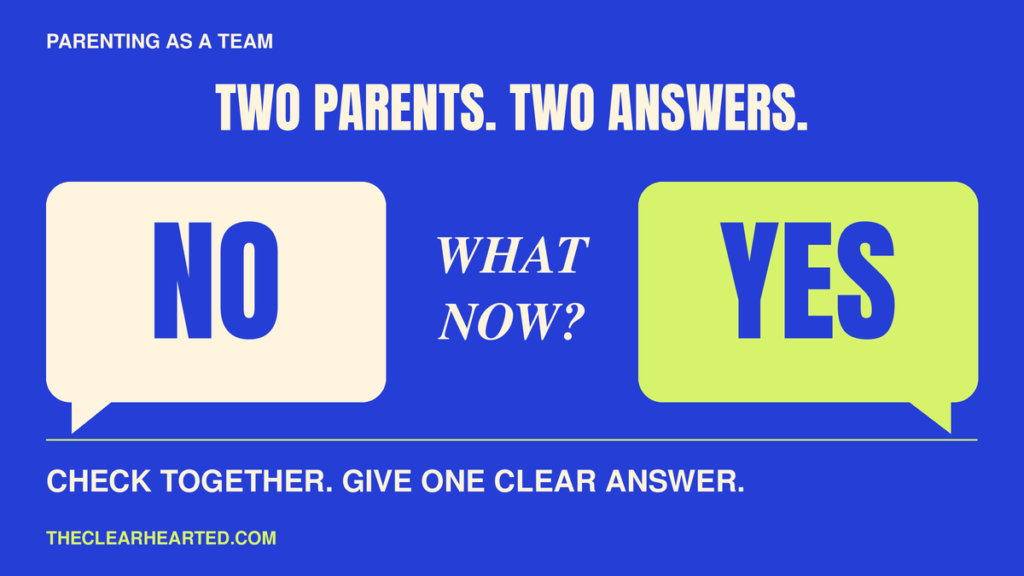
The visit is almost over when your child asks for another hour with a tablet. You already said no. His mother says, “It’s fine at Grandma’s house,” and hands it back. You look at your husband. He looks down at his plate.
Later, you can argue with his mother about screens. In the moment, though, the sharper feeling may be that you were left to defend a decision the two of you were supposed to make together. If his family overrides your parenting rules and he stays quiet, the next conversation belongs with him first.
You do not have to turn one awkward afternoon into a permanent family feud. You do need a workable plan for the next visit: which decisions belong to you as parents, who will speak when a boundary is crossed, and what your child will hear from both of you.
Decide which rule you are actually defending

Photo: Vitaly Gariev / PexelsOriginal photo on Pexels
Some grandparents keep different snacks and later bedtimes. A family can choose to allow that. The question is whether both parents agreed to the exception before a relative announced it to the child.
Write down the specific event before you talk: “I said no more tablet time because bedtime was in an hour. Your mother gave it back while our daughter was standing there.” That is easier to discuss than “Your family never respects me.” One account names a decision and an action; the other invites a debate about everyone’s character.
Separate preferences from rules that matter for health, safety, or a child’s particular needs. A second cookie and a food allergy do not call for the same level of flexibility. You can negotiate an occasional exception to the first. Treat the second as a firm boundary, even when a relative finds it inconvenient.
Also ask what your husband understood. He might think you both allow extra screen time at Grandma’s, while you thought your answer would stand. That does not erase your frustration. It tells you whether you need agreement on the rule, agreement on how to communicate it, or both.
The three things to say before the next visit
Have this talk without your child or his family present. Pick a calm time, not the drive home when everyone is tired. You can use these sentences in your own voice; their purpose is to make a concrete agreement, not to win a courtroom case against his mother.
1. Name the moment and the effect
“When I said no to more tablet time and your mother gave it back, I looked to you and you stayed quiet. I felt alone in a decision I thought we had made together.”
That sentence does not require him to agree that his mother meant harm. If he says she was only being generous, you can answer, “She may have meant well. I still need to know what we will do when someone changes our answer in front of our child.” Intent and impact can both be discussed, but intent alone does not settle the plan.
2. Agree on the rule before asking for backup
“Do we both want the usual screen limit to apply there? If you want a different rule at your parents’ house, let’s decide it together before we go.”
This gives him room to disagree without leaving you to discover his position in front of the family. You may settle on thirty extra minutes on Saturday, or you may keep the usual limit. Either is a real decision when both parents know it beforehand. If you cannot agree, choose a temporary default and revisit it privately. A relative should not become the deciding vote in your disagreement.
3. Decide exactly what he will say
“If your mother offers another answer after we’ve decided, will you say, ‘We already agreed on this. Please check with us before telling her yes’?”
Notice how specific this is. “Back me up” can mean something different to each person. A sentence he is willing to say makes the request clear. He might choose gentler words that fit his family: “Mom, thanks, but we’re stopping screens now.” The useful part is that he speaks as a parent, while your child hears one answer from the two adults responsible for it.
If he says he freezes around his parents, take that seriously without making you responsible for every confrontation. Decide on a small signal he can act on: you say “We need a parent minute,” he joins you, and then he delivers the answer. A plan can be modest and still be meaningful if he actually uses it.
What to say when it happens again

Photo: khezez | خزاز / PexelsOriginal photo on Pexels
Even a good conversation at home will not control another adult’s behavior. At the gathering, keep your response short: “We’ve decided to stop screens for tonight.” If your child heard Grandma’s yes, add, “Grandma didn’t know our plan. The answer is still no for tonight.” You can be polite without treating an already settled decision as an open vote.
Your husband’s part is to reinforce it in his own words. He need not scold his mother in front of everyone. A calm “We’ve got this” can be enough for a minor exception. For a repeated violation, he may need to be more direct: “Please ask us before you offer that again.”
If you and he genuinely disagree in the moment, take a private minute. Tell your child, “We gave you different answers. We’ll talk and come back to you.” This keeps your child out of an adult contest. Our article on what to do when your spouse contradicts you in front of the kids covers that situation in more detail.
Let him handle his own family without disappearing yourself
It may feel unfair that the parent whose family crossed the line should speak up, but he has a relationship with them that you cannot manage for him. He knows which words they hear and when they are likely to push back. Ask him to use that position, while you remain free to speak about your child’s needs.
The goal is not to make every family visit a test of loyalty. It is to avoid a pattern where he is treated as the pleasant son, you are treated as the difficult daughter-in-law, and your child learns to ask the relative who will give the preferred answer.
If his parents are providing regular childcare, plan the conversation before you need it in a crisis. Thank them for the help, explain the few rules that must stay consistent, and tell them where they have room to choose. “You can decide which game to play after dinner; we need bedtime to begin at eight” is clearer than a long list of prohibitions.
If a relative repeatedly refuses a rule that protects your child, decide what access or unsupervised time is workable. That decision depends on the rule and the child, and it belongs to the parents. You do not need to keep offering the same situation and hoping the next visit will be different.
If he thinks you are making it a bigger issue than it is
Ask him to picture the roles reversed. If your father told your child yes after your husband had said no, would he want you to stay silent? The point is not to prove his family is worse. It is to find out whether both parents’ decisions count in front of relatives.
You can also name the extra work created by silence. You end up explaining the rule to your child, negotiating with the relative, and later persuading your husband that it mattered. That is three conversations arising from one moment. If the invisible work of coordinating family life is familiar, our article on managing everything even when your husband helps explores that wider pattern.
If he does not agree with the rule, invite a genuine parenting discussion. If he agrees privately but repeatedly leaves you alone when his family ignores it, pay attention to the gap between the agreement and what he does. You can ask for a smaller, clearer action, but you cannot perform his part for him.
What your child needs to hear
Children do not need a speech about difficult in-laws. They need a clear answer that does not ask them to choose sides. Try: “Grandma was trying to be kind. Mom and Dad decided screens are done for tonight.” If your husband did not back the rule in the moment, make the joint answer true by speaking together afterward.
Avoid saying “Grandma never listens” to a child who loves her. Save the adult conversation for adults. And do not blame the child for asking again when different adults have given different answers; many children would check.
What if the rule is different at their house?
That can work when both parents agree and explain the exception in advance. “At Grandma’s, you can stay up thirty minutes later on Saturday” is a family choice. It becomes a problem when a relative announces the exception after a parent has already answered.
Should I confront his mother myself?
You may speak up for your child, particularly on safety or health. For recurring ordinary rules, ask your husband to share the conversation with his family so you are not the only person enforcing a decision you made together.
What if my husband agrees with me at home but goes quiet every time?
Ask what makes speaking difficult and agree on one sentence or signal for the next visit. Then notice whether he follows through. Repeated silence is useful information about the partnership you are trying to build; another perfectly worded request may not solve it by itself.
The measure of progress is simple: next time someone offers your child a different answer, do the two of you respond as parents who have spoken to each other first?
Clearhearted publishes general educational content about relationships and parenting. It is not therapy, counselling, medical, or legal advice and cannot account for your specific situation. See our Disclaimer.