Three days ago you’d have said things were fine. Now the replies are shorter, the plans have thinned out, and you are doing the thing where you scroll back through messages looking for the moment it changed.
The problem is that two completely different situations produce identical evidence.
What the research says about fading
Ghosting — ending a relationship by cutting off contact entirely — has been studied properly over the last decade, and one finding reframes the whole thing.
Freedman, Powell, Le and Williams (2019), across two studies with over 1,300 participants, looked at what predicts ghosting. The answer wasn’t cruelty or indifference. It was a belief about how relationships work.
Psychologists distinguish two implicit theories. People with destiny beliefs think partners are either compatible or they aren’t, and that a relationship which doesn’t start smoothly was never going to work. People with growth beliefs think relationships develop over time and that difficulty can strengthen them.
Stronger destiny beliefs were associated with viewing ghosting more positively, with stronger intentions to ghost, and with having actually done it. A later multi-study paper from the same researchers also found that people who had ghosted reported higher attachment avoidance.
Key takeaway
People who fade often aren’t delivering a verdict on you. They hold a theory in which relationships that require effort weren’t meant to be — so when things get effortful, they conclude rather than communicate.
That doesn’t make it less painful. It does mean the hours you spend auditing yourself for the fatal mistake are often looking for something that was never there.
What actually separates the two
Reduced contact is common to both. Four things aren’t.
Whether it was named. Taking space is usually announced, even clumsily — work is brutal right now, I need a few days. A fade arrives without narration, because narration would require a conversation, which is the specific thing being avoided.
Whether there’s an end. Space tends to have edges. I’ll call you at the weekend. A fade has no horizon; each contact is slightly less than the last with nothing to look forward to.
Whether the warmth survives. Someone genuinely under pressure is often still warm in the little contact there is — brief but affectionate. A fade cools in temperature as well as frequency, and the coolness is usually the earlier signal.
What happens when you make it easy. Offer something small and specific — a coffee, half an hour, a walk. Someone with genuinely no capacity will decline and propose something else. Someone fading will decline and propose nothing.
The tell that matters most
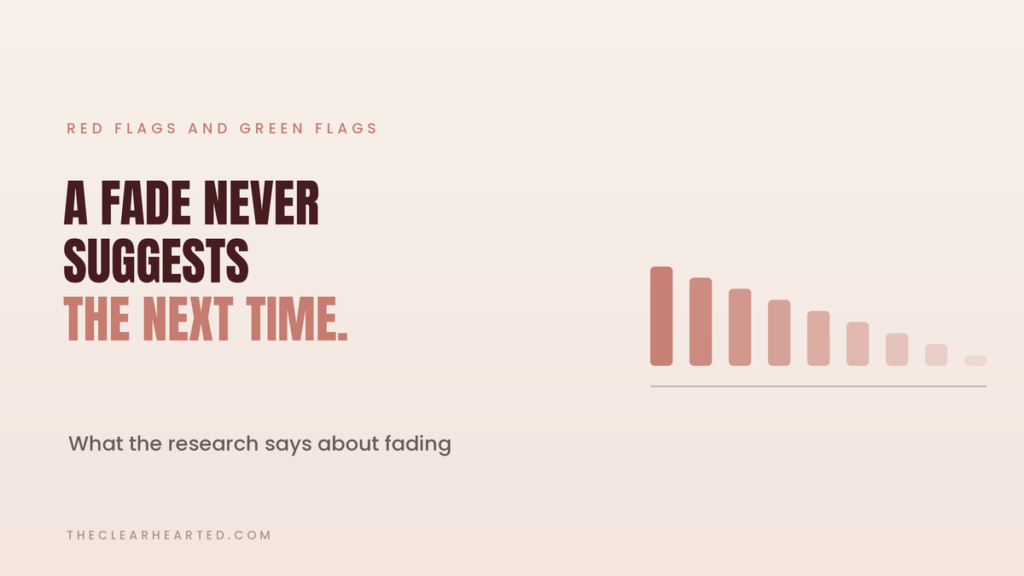
Watch who suggests the next thing. Space means someone is pausing and intends to return, so they’ll usually gesture at a return. A fade never proposes a next time. Everything in it is a reply to you.
The one way to know
You can ask. Most people won’t, because asking feels like it might cause the ending — as if naming it makes it real.
It doesn’t. It just brings the timeline forward.
I’ve noticed we’ve been talking less. I’d rather know where you’re at than guess. No hard feelings either way.
Three sentences, no accusation, and it explicitly gives permission to say something you don’t want to hear — which is precisely what makes it likely to produce a real answer.
And if he doesn’t reply at all? That’s an answer too, and a complete one.
What to do next
Before you ask anything, look back over the last fortnight and count how many plans he initiated. If the answer is none, you already have your answer and the message is confirmation rather than investigation.
What not to do while you wait
Don’t audit the archive. Rereading old messages for the fatal error is the most seductive and least useful thing available. The research above suggests the cause is frequently in the other person’s model of relationships, not in something you said on a Thursday.
Don’t escalate to get a reaction. A dramatic message will produce a reply, and the reply will be about the drama. You’ll have traded a clear answer for a muddy one.
Don’t match his energy as a strategy. Going quiet to see whether he notices turns the whole thing into a contest that neither of you can win, and it costs you the clarity you actually wanted. More on that in what to do when he takes hours to reply.
If it turns out to be a fade
The hardest part of a fade isn’t the ending. It’s the absence of a moment to point at, which leaves you without anywhere to put the feeling.
Worth knowing: the research suggests fading is often a trait of the fader rather than a judgement of the faded. Someone who ends things by disappearing has usually done it before and will do it again, to people who did nothing wrong either.
That’s not consolation exactly. But it’s more accurate than the story where you find the mistake, and accuracy is worth something at three in the morning.
Clearhearted publishes general educational content about relationships. It is not therapy, counselling, or medical advice, and it cannot account for your specific situation. See our Disclaimer.