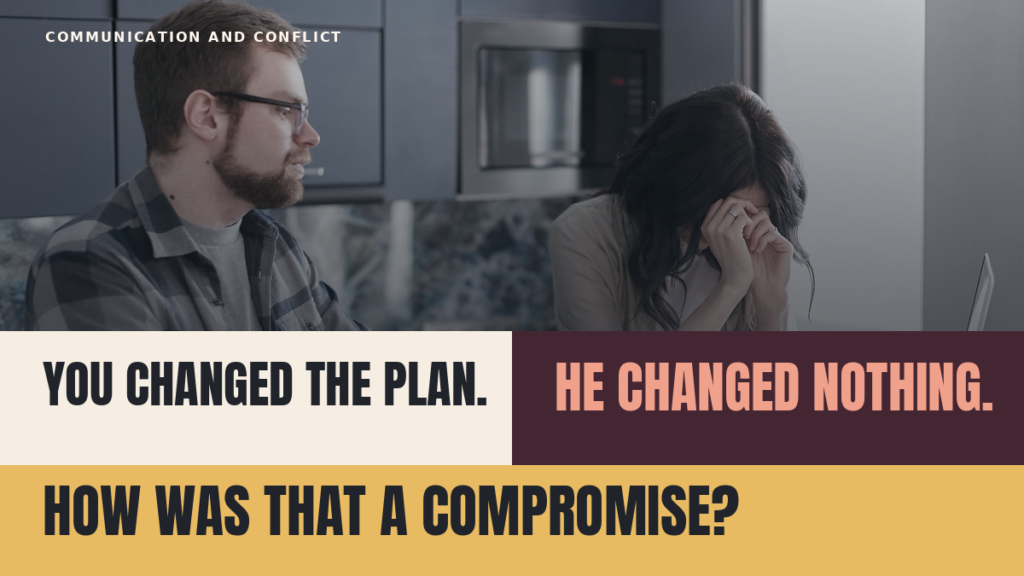
You wanted Saturday afternoon with your sister. He wanted the whole day together. You suggested meeting him for dinner after the visit. He said dinner felt rushed, so you shortened your sister’s visit and drove to him at three. He called that meeting in the middle.
On its own, the day may not mean much. Couples adjust plans. One person travels farther some weekends; the other needs rest another time. But if the details change and the ending stays the same—your plan gets smaller while his remains intact—you may be calling a concession a compromise because “concession” sounds too difficult to say aloud.
You do not need a courtroom accounting of every hour. You do need to know what each person wanted, what each person gave, and whether both had a real choice.
A compromise should name two real preferences
Try reconstructing the conversation before assigning blame. What did you first ask for? What did he ask for? What arrangement did you make? What did each of you change to get there?
Suppose you wanted to see your sister until six and he wanted dinner together at seven. Leaving at five might genuinely work for both of you, especially if the travel is short. But if his “middle” required you to leave at three, drive across town, and skip the part of the visit you valued, the cost was yours. The label does not change the arithmetic.
Sometimes the cost is invisible in the final plan. He agrees to a trip if you research the hotel, book it, arrange the transport, and work out the budget. He has moved on the destination; you have inherited the labor of getting there. Look at time, money, effort, and lost opportunities—not only which restaurant or day appears on the calendar.
This does not mean every agreement must be exactly equal on every occasion. Illness, caregiving, distance, and work schedules can make an even split impossible. Fairness is a pattern you can talk about, not a stopwatch you use against a tired partner.

Where the “middle” can move without you noticing
Sometimes one person begins with an extreme position: “Either spend the entire weekend with me or you don’t care.” You offer Saturday evening as a middle option. The final agreement sounds moderate only because the opening demand was so large.
Sometimes you bargain from a fear of disappointing him. Before he has asked you to change anything, you present the smaller version of what you want. He says yes, you feel relieved, and neither of you discusses the preference you never put on the table.
Other times, both of you are sincere but using different measures. He counts the hours together; you count the fact that you did all the travel. If you keep debating who sacrificed more without naming the measure, the argument may never reach the problem.
The way forward is concrete. Pick one recent agreement and describe the changes each person made. Avoid “you always win,” which invites a defense about exceptions. A single example with an honest timeline is easier to examine together.
Four questions before the next agreement
1. What did we each ask for at the start? Say your full preference before offering a reduced version: “I want Saturday afternoon with my sister and dinner with you afterward.” Invite his actual preference too. You cannot find a shared solution when one person’s starting point is hidden.
2. What does each person change in this plan? If the answer is “you change your timing, transport, and visit; he changes nothing,” call it what it is. A one-time favor may still be freely chosen. It does not need to be dressed up as an equal trade.
3. Who handles the work that comes after we agree? An itinerary, a childcare arrangement, an awkward cancellation, or the drive home at midnight can all be part of the decision. “You can go if you arrange everything” is different from “Let’s make that possible together.”
4. If this happens again, what will we do differently? Perhaps he drives next time, or you reserve the day with your sister and make Sunday your time together. A compromise that feels uneven once can be repaired; a repeated pattern needs a new rule.
These questions are not a form you have to read aloud. They are a way to keep the trade-offs visible while you decide.
What to say without starting a scorekeeping fight
You can begin with the moment rather than his character: “When we called Saturday a compromise, I left my sister’s early and drove to you. I don’t think you had to change your plan. I’m willing to be flexible sometimes, but I don’t want that to be the default.”
If he says you agreed, acknowledge the part that is true: “I did agree. I’m realizing I agreed because I wanted the conversation over. I’m bringing it up now so our next plan is fairer.” Taking responsibility for your yes does not require you to repeat it indefinitely.
If he reminds you of something he gave up last month, you can distinguish the two discussions: “I remember that, and I appreciate it. I want to talk about this Saturday first, then we can look at whether the bigger pattern feels fair to both of us.” You need not deny his effort to describe yours.
If the conversation pivots to whether you sounded grateful enough, return to the decision itself. Our article on when you raise a problem and end up defending your tone looks at that detour in more detail.

When you willingly choose the less convenient option
Generosity is not a mistake. You may happily take the late train so he can rest before work, or cover more of a bill while he is between jobs. The problem isn’t unevenness on one day. It is being unable to name an uneven cost without becoming the difficult one.
Ask whether you would make the same choice if there were no pressure, no sulking afterward, and a genuine option to say no. If the answer is yes, you can give the favor freely. If the answer is “I don’t really get to choose,” the word compromise is concealing a different issue.
Also pay attention to how your partner responds when you need the easier option. A relationship can survive uneven weeks when both people notice the imbalance and make room for each other over time.
When the agreement involves bigger decisions
A move, joint spending, family holiday, or change in work hours can carry consequences beyond one missed afternoon. Slow down. Put both options, costs, and responsibilities in writing for yourselves before making a decision. If finances or legal responsibilities are involved, seek appropriate professional advice for those facts.
Do not let “we already agreed” stand in for a conversation about new information. If a cost becomes visible only after the plan is made, return to it. Fairness sometimes requires revising an agreement rather than defending it because the first conversation was difficult.
For everyday decisions, the same principle works in a smaller form: “Let’s pause. I think I just agreed to do all the driving. Can we rework that part?” You are allowed to notice the fine print before the evening begins.
FAQ: What if he says every relationship requires sacrifice?
He is right that partners sometimes give up a preferred option. Ask for a specific account of this decision rather than debating the virtue of sacrifice. Who is giving what this time? Can the pattern be reciprocal? A true statement about relationships does not settle whether this arrangement is fair.
FAQ: Am I keeping score by noticing?
Noticing a pattern is different from bringing up every old favor to win an argument. Use one or two examples to explain why you want a different process. You can stop tallying once both people can see and share the work. If help routinely becomes a debt you must repay, our piece on when every favor becomes something you owe covers that separately.
Choose a plan you can both describe honestly
Before saying yes again, state your full preference and ask what he is willing to change. If the final plan asks more of you, you can still choose it. Call it a favor if that’s what it is, and let the next decision make room for your needs.
The goal is not to win the middle. It is to make a shared plan without one person’s life quietly becoming the flexible part every time.
Clearhearted publishes general educational content about relationships. It is not therapy, counselling, medical, financial, or legal advice. See our Disclaimer.


