The favor comes back during an unrelated argument
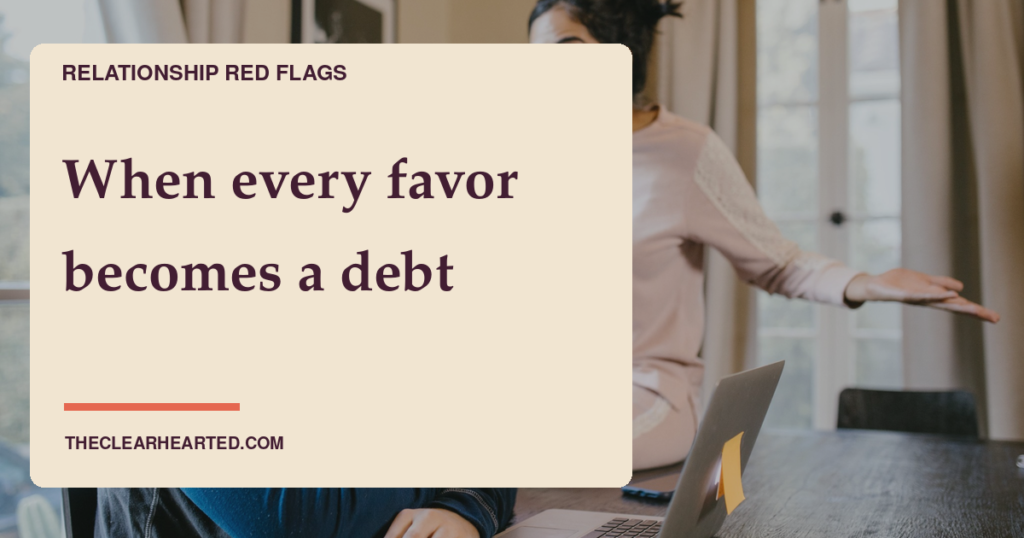
He drove you to the airport last month. You thanked him and meant it. Now you are disagreeing about the weekend, and the ride appears again: “After everything I do for you, you can’t even do this?”
The problem is not that he remembers his effort. People need to feel appreciated, and relationships require give and take. The problem is that a favor offered as a choice is being used later as leverage over a different choice. You are no longer discussing the weekend; you are defending whether you deserve the airport ride.
That shift can be subtle. A single exasperated comment may lead to an honest conversation about feeling unsupported. A recurring ledger, where each act of help becomes a reason you should surrender a boundary, deserves closer attention.
Reciprocity is not a hidden price tag
In a healthy exchange, you can acknowledge an imbalance directly. “I’ve been doing most of the driving lately. Can we share it next month?” is specific and gives both people a chance to respond. So is agreeing in advance that you will cover dinner because he bought tickets.
A hidden price tag appears afterward. He says he was happy to help, but when you decline a plan he lists what he has paid for, carried, or fixed. The terms seem to change depending on what he wants. If you ask what would feel fair, he may say you should “just know.”
This can happen even in couples who rarely talk about money. One partner earns more and assumes each purchase counts as a vote. The other does more unpaid work and feels invisible when the bills are cited. An honest conversation about resources may be overdue; an argument that treats money as authority over someone else’s choices is a different problem. Put the actual contributions and expectations on the table, rather than letting a vague claim of sacrifice decide every future disagreement.
Notice whether the scorekeeping goes both ways. Do your contributions count? Does he recognize the quiet work of scheduling, remembering, listening, or rearranging your own plans? A ledger that records only one person’s visible favors can make the other person feel perpetually behind.
Three versions of “you owe me”
Sometimes the debt is about practical labor: “I cleaned the kitchen, so you should handle the trip.” That may be negotiable if both people can discuss the overall division of work.
Sometimes the debt is emotional: “I listened to you last week, so you have no right to be upset with me today.” Listening isn’t a voucher that cancels a later concern.
And sometimes it reaches your boundaries: “I bought dinner, so you owe me more time” or “I helped you move, so you can’t say no.” A gift or favor does not create a claim on your body, time, or consent. Treat pressure around those choices seriously.
The point is not to label every mention of past effort as manipulation. It is to notice whether appreciation is being requested openly or extracted through guilt.
What to say when the old favor appears
You can acknowledge the favor without agreeing that it settles the present question:
“I appreciated the ride, and I thanked you for it. I didn’t understand it as an agreement about this weekend. Let’s talk about the weekend on its own.”
If the issue is a genuine imbalance, make it discussable: “If you feel that you’re doing more driving, let’s make a plan for future trips. I don’t want to find out what I owe only when we’re arguing.”
This response does two useful things. It refuses the surprise invoice and leaves room for him to say what he needs. Someone who wants fairness can usually work with that. Someone who needs the debt to remain vague may resist making an actual agreement.
If you previously offered something in exchange, be fair about that too. “You drove me, and I said I’d pick up the groceries. I haven’t done it yet; I will tomorrow” is more useful than pretending no agreement existed. Clarity works in both directions. It lets you take responsibility for a real promise while declining an obligation nobody actually discussed.
Before you accept the next favor
If the pattern has repeated, it is reasonable to ask about expectations upfront. “I can get there by train. If you want to drive me, thank you, but I don’t want it brought up later as a reason I have to agree to something else.” The sentence may feel awkward. That awkwardness is useful information about how the help has begun to feel.
You can also decline help and make your own arrangement. That is not a punishment or a test; it may be the simplest way to keep a choice free. If the issue is shared money or household work, agree on who handles what before resentment accumulates. Explicit arrangements can protect generosity by keeping it from becoming a guessing game.
The same principle applies to small, repeated household tasks. If he says he always takes out the rubbish and you say you always arrange appointments, stop comparing the two only when you are angry. List the responsibilities, including planning and follow-through, and decide together what each person owns. You may discover an imbalance worth fixing. You may also discover that the “favor” he repeatedly cites was already his agreed part of running your shared life.
What repair would actually look like
An apology for bringing up the ride matters more if the next disagreement stays on its own subject. Does he stop listing past favors when you say no? Can he tell you directly when he feels overextended? Does he accept that your gratitude and your autonomy can exist at the same time?
Notice your own habits too. If you find yourself performing extra appreciation to prevent a future argument, or refusing all help because you fear a bill, the dynamic is shaping everyday life. You can ask for change. You can also decide that a relationship in which every kindness becomes a bargaining chip does not feel like a partnership.
If a favor is used to pressure you into intimacy, isolate you, or make you afraid of the consequences of declining, prioritize safety and talk with a trusted person or support service. For the ordinary but exhausting version, ask one clear question: Can he do something kind without needing to own your next answer?
Clearhearted publishes general educational relationship content. It is not therapy, counselling, medical, or legal advice and cannot account for your specific circumstances. See our Disclaimer.