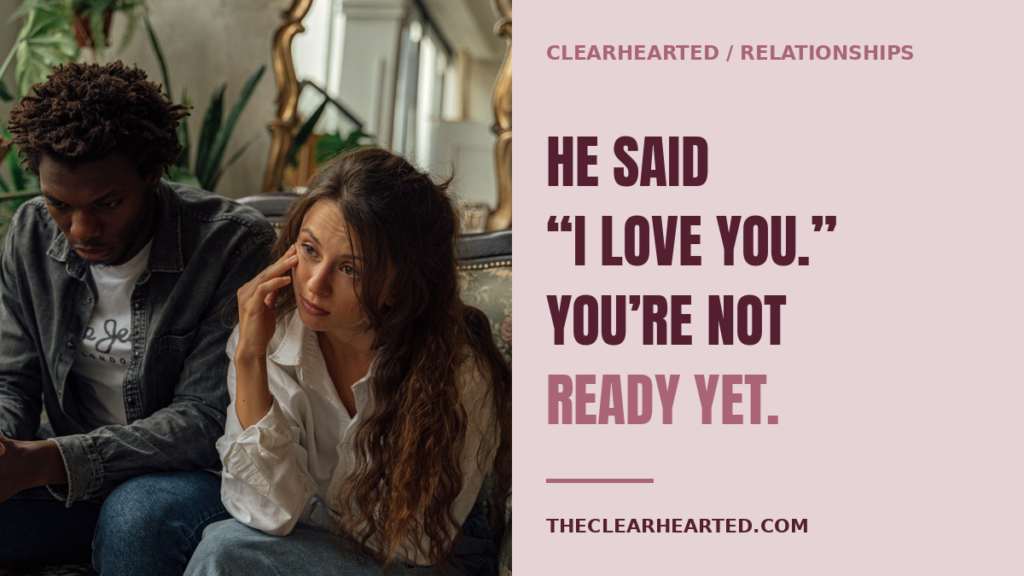
He said, “I love you.” You care about him, perhaps a great deal. But the words did not arrive in you at the same moment they arrived in him. You froze, smiled, or changed the subject. Now you are replaying it, worried that honesty sounded like rejection.
If you are not ready to say I love you back, you can respond with warmth and truth. You do not owe an identical sentence on the same day. What you do owe, if you want to keep building the relationship, is clarity about what you can say and how you want to move forward.
First, you do not need to fill the silence with a lie
An “I love you too” said only to spare someone’s feelings can create more confusion later. He may understandably hear it as a shared milestone; you may feel trapped by words you did not mean. A brief pause, a breath, and a genuine response are kinder than a reflex you will have to explain away.
You can be moved by his feelings without being ready to name yours the same way. People’s timelines differ. Some need to know someone through difficult days as well as lovely ones. Some have been hurt before. Some simply take longer to use those words. None of those explanations needs to become a defense speech in the moment.
If you did say it back automatically and regret it, you can still correct the impression. Try, “I reacted quickly because I care about you and didn’t want to hurt you. I need to be honest: I’m not sure I’m ready for those words yet. I want to keep getting to know you.” Awkward truth is better than maintaining a story you cannot inhabit.
Four honest replies that are not a lie or a rejection
Choose the one that is true for you; do not recite it like a line from a movie.
1. “That means a lot to me. I care about you so much.” Use this if you are touched and want him to know the feeling matters, even though you are not ready to match the exact words.
2. “I’m really happy with us. I want to keep building this, and I need a little more time before I say that back.” Use this when you feel a future here and want to be explicit about the timing.
3. “Thank you for trusting me with that. I don’t want to say it before I mean it, but I don’t want you to mistake my pause for indifference.” This works when the silence itself may be easy to misread.
4. “Can we sit with that for a moment? I care about you, and I want to answer honestly rather than quickly.” Use this when you are surprised and genuinely need time to find your words.
These responses do not promise that you will eventually say it. If you already know you do not see a future with him, do not use “just give me time” as a way to postpone a difficult truth. You can be gentle without implying a certainty you do not feel.

Source: Andrea Piacquadio on Pexels
What if he looks hurt?
He might. Saying something vulnerable and not hearing it back can sting. You can acknowledge that without changing your answer: “I can see that landed painfully. I’m glad you told me, and I don’t want to pretend about where I am.” Give him room to feel disappointed rather than rushing to manage every second of his reaction.
His feelings also do not create an obligation for you to catch up overnight. If he asks, “Will you ever say it?” and you do not know, answer that question honestly: “I don’t know yet. I do know I want to keep seeing where this goes.” If you need to slow the relationship down, say so. Clarity is more useful than a comforting prediction.
If he repeatedly demands an answer, sets a deadline, or treats every date as a test, talk about that pressure. “I want these words to come from me freely. Being asked every day makes it harder to understand what I actually feel.” His willingness to give you room matters.
Ask yourself what “not ready” means
Sometimes it means the relationship is promising and still young. Sometimes you feel affection but do not trust the connection yet. Sometimes you have noticed a mismatch and are reluctant to name it. Those are different situations, and you do not need to force them into one polite answer.
Consider what you know about him beyond the most romantic moments. Can you disagree safely? Do you know how each other handles disappointment? Have you spent enough ordinary time together to feel seen? These questions are not a checklist for love. They can help you understand whether you are waiting for time, information, or a change that may never come.
Do not compare your timeline with friends’ relationships. An early “I love you” is not automatically a warning, and a later one is not automatically more sincere. What matters is whether both of you can tell the truth without being punished for it.
If your uncertainty is less about the words and more about where the relationship stands, When to Have the “What Are We” Conversation covers a different but related talk about timing and expectations.
What to say the next day if you froze
You do not have to leave an awkward moment unexplained. A short follow-up can restore warmth:
“I’ve been thinking about what you said. I was caught off guard and
didn’t want my silence to seem dismissive. I care about you and like
what we’re building. I’m not ready to say those words yet, and I want to
be honest about that.”
Then stop. Let him respond. You do not need six paragraphs explaining your childhood, every relationship you’ve had, and your prediction for the next six months. If he wants to discuss what the words mean to each of you, that can be a useful conversation.
Some people say “I love you” to express affection in the moment; others hear it as a promise about a shared future. Ask, “What did it mean to you when you said it?” That can reveal whether the two of you are talking about the same thing.

Source: Craig Adderley on Pexels
Be kind without promising a date
Avoid “I’ll say it in a month” unless you can truly know that, which most people cannot. The more honest promise is about behavior: “I’ll keep being open with you about how I feel.” He can decide whether that pace works for him. You can decide whether you feel free to move at yours.
If your feelings do deepen, the words can come later without a countdown. If they do not, you will have been honest along the way. A relationship where one person says it first can still be a caring relationship; the moment becomes difficult when truth is treated as a test both people must pass at once.
The sentence you can take with you
If you are not ready to say I love you back, try: “I care about you, and I want to be honest about where I am.” Add what is true after that. You can receive his vulnerability, make room for his feelings, and keep your own words meaningful.
Quick questions
Should I text him about it if I froze? A short, honest follow-up is fine. Choose text if it helps you get the words out, then leave room for a conversation.
What if he says it very early? Ask what the words mean to him and observe whether he respects your pace. You do not need to decide the whole future that day.
What if I never feel ready? That possibility deserves honesty with yourself and, when you understand it better, with him. Do not use a promise of later to conceal a clear no.
Clearhearted publishes general educational relationship content. This article cannot assess your specific situation or replace professional support.