
The sentence lands while you are putting away dinner plates: “Dad’s house is better. I want to live with Dad.” You feel yourself searching for evidence that your home is good enough. But the first minute is a poor time to argue your case. When your child says “I want to live with Dad,” your immediate job is to understand what happened before the sentence, make room for the feeling, and keep adult decisions with adults.
Children can miss one parent while they are with the other. They may also be angry about a rule or worried that praising Dad’s house will hurt you. None of that alone tells you what living arrangement is best. The American Academy of Pediatrics advises parents not to force children to take sides.
First, do less for thirty seconds
Put down what you are holding. If you can, sit near your child and say, “You really want to be with Dad right now. Tell me what you’re missing.” Then let the silence last long enough for an answer. A child may say, “He lets me stay up,” or “I miss him,” or “You were mean this morning.” These are different conversations.
You do not have to agree to a move to hear the wish. Nor must you answer every question about a schedule on the spot. If you are too shaken to listen well, say, “I want to hear you. Give me a few minutes to settle, and then let’s talk.” Keep the return promise.

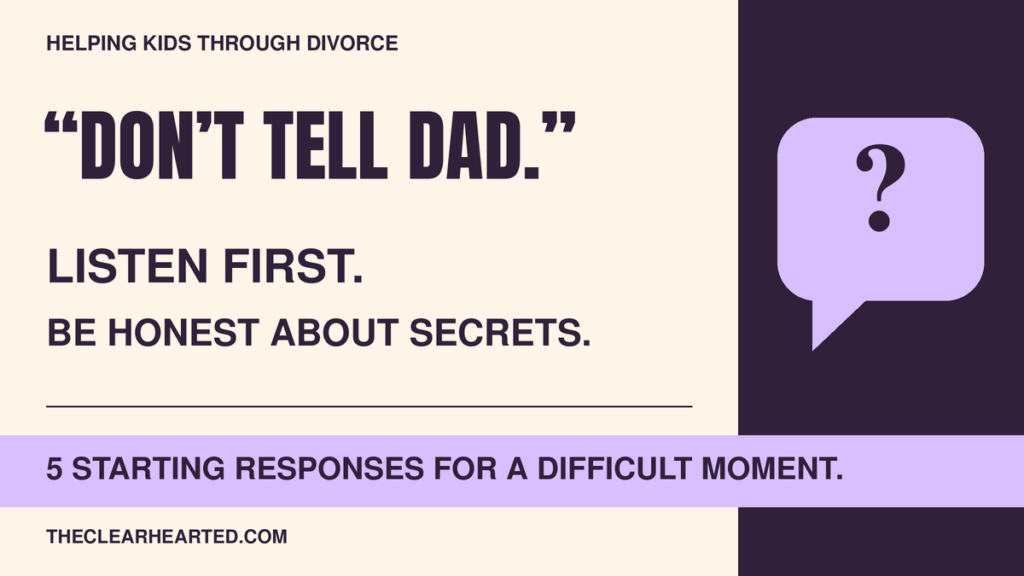
Five responses that keep your child talking
1. When the wish is really about missing Dad
Try: “It makes sense that you miss him. What part of being there are you thinking about today?” The answer may be a bedtime ritual, a pet, a sibling, or simply more time. If a call or visit is already agreed, name the real plan: “You can call after homework, and you’ll see him Saturday.” If no plan is confirmed, do not invent one to ease this minute.
Missing someone does not mean your child loves you less. They should be free to talk about the other parent without managing your face. If you know the ache of an empty house when the children leave, our gentle plan for the first night they stay with Dad speaks to your side of that separation. Let your adult support carry your adult feelings.
2. When it follows a rule at your house
Try: “You’re angry that I said no to the sleepover. I hear you. The answer tonight is still no, and we can talk about what made that feel unfair.” A request to live elsewhere made five minutes after a limit may be a way to say, “I hate this rule.” You can acknowledge the anger without negotiating where your child lives through the argument.
Ask later, when both of you have cooled down, whether the rule itself needs another look. Sometimes it does. But promising a changed schedule to end a fight teaches everyone that the biggest decision is made in the hottest moment. Repair the tone if you snapped: “I raised my voice. I’m sorry. We still need to discuss the sleepover.”
3. When Dad’s house seems easier
Try: “What feels easier there?” Listen for specifics instead of assuming it is just fewer chores. Perhaps their homework materials are always in one place. Perhaps the handoff is tiring, or their friends live closer to Dad. A child can describe a practical difficulty accurately even if their proposed solution is bigger than the problem.
Write down what you hear afterward. A difficult morning might call for a different backpack plan. If your child says they feel unsafe or frightened, listen without leading questions and seek appropriate local professional help. Do not dismiss a safety concern as an ordinary preference.
4. When they say, “I love Dad more”
Try: “You are allowed to love Dad. You never have to choose which of us to love more to talk to me.” There is no useful score to settle here. The words may be aimed at hurting you, but your child still needs a parent who can hold a strong feeling without turning it into a loyalty test.
Later, if the words were meant to wound during an argument, you can set a respectful limit: “You can tell me you’re furious. We won’t use love as a weapon when we’re angry.” That limit is about how you talk, not about which parent is entitled to your child’s affection.
5. When the request is calm and repeated
Try: “I hear that this is something you keep thinking about. Tell me what you hope would be different. I’ll take it seriously. The adults are responsible for decisions about where you live.” A repeated wish deserves attention, especially as children get older. Attention means asking open questions, considering school, friendships and routines, and talking with the other parent in an appropriate adult channel. It does not mean asking your child to campaign for a change.
If there is a parenting agreement or order, avoid promising a new arrangement before you know what can be discussed or changed. This article cannot tell you what your agreement allows. A family mediator or qualified local adviser can help if the adults cannot work through the question safely and constructively.
What to ask after the first wave passes
Choose one or two questions, not an interview: “When did you start feeling this way?” “What happens there that you wish happened here?” “Is there anything here you want us to change?” “Is there something you don’t want to tell me because you’re worried I’ll be upset?” The last question works only if you are prepared to hear an uncomfortable answer without punishing honesty.
Do not ask, “Did Dad tell you to say that?” unless you have a concrete reason to address adult pressure separately. Even if another adult has influenced the conversation, putting your child under cross-examination makes it harder to learn what they genuinely feel. The AAP guidance on supporting children after separation describes the range of feelings children may have and the value of listening to them.

Keep the adult follow-up with the adults
If a discussion with Dad is appropriate, send a factual message after you have calmed down: “She has said a few times that she misses being with you during the week. I’d like us to look at what she means and whether there are practical ways to support her.” Avoid reporting only the sharpest line of the argument, as if your child were a witness for one side.
You can also make one change at your house that is within your control. Perhaps the first evening back has less pressure. Perhaps you reserve a regular time for a call. Perhaps your child needs to know the plan sooner. A small, reliable improvement is more meaningful than competing to be the more exciting home. If changed visits repeatedly fall through, see what to say when Dad cancels plans rather than promising a visit you cannot confirm.
If your child is persistently distressed, losing sleep, struggling at school, or repeatedly describing fear, involve a pediatrician or an appropriately qualified child professional. Tell them what your child has said without asking them to decide who the “good parent” is.
A short version for tonight
“I hear you. You really want to live with Dad right now. I want to understand what feels better there and what has felt hard here. You don’t have to protect my feelings, and you don’t have to decide the grown-up plan tonight. Can you tell me more?”
The sentence may still hurt. You can take that hurt to a friend, counselor, or journal after the conversation. Your child gets a listener; you get support too.
Questions parents often ask
Should I tell my child the custody schedule cannot change?
Tell them only what you know: “This week’s plan is the same. I will listen to what you’re asking and discuss it with the adults involved.” If a legal arrangement applies, do not promise either that it will change or that it never can. Seek local advice for the specifics.
What if my child says this every time I set a boundary?
Treat the feeling as real while keeping the boundary: “You’re upset with my answer. We can talk about that, and we are not deciding where you live during this argument.” Revisit the recurring issue later. If there is more underneath it, listening when everyone is calm will reveal more than debating the threat.
What if Dad says my child wants to move in with him?
Ask to discuss your child’s needs directly between adults, without asking your child to repeat a case for either household. Notice what your child says in their own words over time. If disagreement becomes a formal dispute, use the support available in your location rather than putting your child in the middle.
Clearhearted publishes general educational information about parenting and relationships. This article is not individualized therapy, medical, safeguarding or legal advice.


Conversation
Comments are closed.