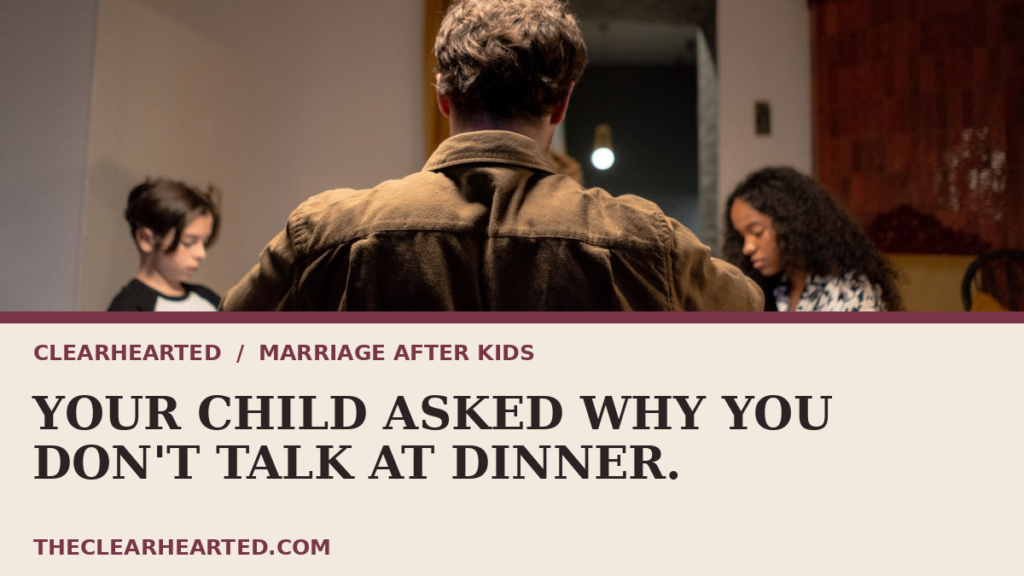
You and your husband have spent the week speaking in useful sentences: “The permission slip is on the counter.” “I’ll pick her up at five.” At dinner you serve the food, answer the child’s questions, and barely look at each other. Then your child asks, “Are you two mad?”
If you are wondering what to tell kids when parents aren’t talking, start with a short, honest reassurance. They do not need the details of your conflict, and they should not be asked to repair it. The adults can take the harder conversation somewhere private.
What to say in the moment
Try: “We’ve been quiet with each other today. That’s something for us to work out. It isn’t your fault, and you don’t need to fix it.” If you know you are both tired, you can add that: “We’re tired and we still care about you.” Keep it true. You do not have to promise that everything will be perfect tomorrow.
For a younger child, use fewer words: “Mom and Dad are having a hard conversation. The grown-ups will handle it. You are safe and loved.” For an older child who asks a follow-up, acknowledge what they saw: “Yes, we’ve been distant. We are going to talk privately. You can ask us if something worries you.”
Answer the question your child actually asked. If they ask whether you are angry, “We are upset with each other and working it out” is clearer than “Nothing is wrong” when the silence is obvious. If they ask whether you are getting divorced and that is not something you have decided, say so. Do not invent a permanent promise you cannot control; reassure them about what you can do today: care for them, listen, and keep adult decisions with the adults.
Four things your child needs from this conversation
1. A name for what they noticed
Children can see adults avoid one another without knowing why. “We’ve been quiet” or “We disagree about something” gives the scene a simple name. Avoid details about money, intimacy, relatives, or who said what. Those subjects belong in an adult conversation.
You may be tempted to say, “Ask your father why he’s upset.” That turns the child into a messenger and asks them to investigate one parent for the other. Instead, tell your partner what you need directly after dinner.
2. Freedom from blame
Say plainly, “You did not cause this.” Even if the disagreement began over something connected to school or parenting, the adults are responsible for handling their own feelings and decisions. Your child should not be asked to act differently to make the two of you speak again.
The American Academy of Pediatrics notes that children learn from how parents communicate. A short, respectful repair can model more than a performance of constant harmony.

3. No job as referee or comforter
“Who do you think is right?” is too much to put on a child. So is a private confession about how lonely you feel when your spouse shuts down. Your child can know there is a disagreement without becoming your adviser, witness, or primary source of comfort.
If you need someone to listen, choose another adult. If your child asks how they can help, you can answer: “You don’t have to solve this. You can tell us if you feel worried. We’ll do the grown-up work.”
4. Evidence that adults can take a next step
You need not stage a cheerful conversation for the child’s benefit. A small, genuine step is enough: “We’re going to talk after dinner.” Later, if appropriate, you might say, “We talked. We’re still working through it, and we both care about you.”
If you have already snapped at each other in front of the child, our guide to what to say after a fight the kids heard covers a more direct repair. Quiet distance calls for a different explanation, but the child still deserves clarity.
What the two of you need to discuss privately
Once your child is elsewhere, begin with what happened at the table rather than arguing about whether the child is “too sensitive.” “She asked why we don’t talk. I think we should give her a clear answer and decide how we are handling this between us.”
Then name the problem you have been avoiding. Has an argument gone unresolved? Are you both exhausted and speaking only about logistics? Has one person asked for a conversation and the other refused? Those situations require different responses.
If you are simply depleted, make one small plan for connection away from family management: a walk after school drop-off, fifteen minutes on the sofa without phones, or a conversation about a subject other than chores. Our article on date night becoming a conversation only about the kids offers questions for rebuilding that adult space.
If there is an unresolved hurt, do not skip straight to pleasant small talk. Set a time to discuss the event, allow each person to describe its impact, and agree on one repair. Children do not need the transcript. They benefit when the adults take responsibility for what is happening instead of pretending the room has no atmosphere.

A short example after dinner
Child: “Are you mad at Dad?”
You: “We’ve been quiet with each other, and I can see you noticed. That’s between the two of us. It isn’t your fault.”
Child: “Is it because I spilled the juice?”
You: “No. Spilling juice did not cause this. You can tell us when you’re worried. We’re going to talk about the grown-up problem ourselves.”
Later, to your partner: “She thinks she caused the silence. I told her she didn’t. I need us to agree on what we can honestly say, and then talk about what has been going on with us.”
The exact words matter less than who carries the responsibility. You answer the child’s worry. You do not ask the child to carry the marriage.
What if your partner wants to say nothing?
You cannot force him to speak at dinner. You can tell him what you plan to say if the child asks again: “I won’t share our private details. I will tell her she isn’t responsible and that we’re handling it.” Invite him to choose language he can also stand behind.
If his silence is part of a pattern that leaves every concern unaddressed, talk about that pattern directly. When you stop bringing things up in your marriage explores what can happen when one person experiences quiet as peace and the other experiences it as resignation.
If either adult is afraid to speak because of threats or intimidation, a conversation plan alone is not enough. Seek confidential local support and put safety first. You do not need to teach a child to accept frightening behavior as an ordinary marriage disagreement.
Check in later without making your child monitor you
Later that evening or the next day, ask, “You seemed worried at dinner. Is there anything you want to ask us?” Listen without correcting the emotion. If they say they felt scared, you can say, “I can understand why that felt strange. Thank you for telling me.”
Then return to ordinary life. Your child should not have to report whether you smiled at each other or determine if the repair was successful. Adults can keep checking in with one another. If the worry persists or affects sleep, school, or daily life, speak with your child’s pediatrician or an appropriate qualified professional for advice tailored to them.
The dinner question may be uncomfortable, but it gives you a useful opening: reassure the child in plain words, take the adult conversation out of their hands, and follow through on a next step between yourselves.
FAQ: Should we tell our child what the argument is about?
Usually they need a brief, age-appropriate explanation and reassurance, not the details. If a change will affect their life, explain that change honestly when you know what you can say.
FAQ: Is it better to act cheerful until the child goes to bed?
You can keep dinner civil without pretending a visible silence does not exist. If your child asks, acknowledge it simply and explain that the adults will handle it.
FAQ: What if our child asks the same question tomorrow?
Repeat the reassurance and consider whether you and your partner have actually taken the promised next step. A child’s repeated question may mean they still need clarity; it is not a demand that you settle the marriage overnight.
Clearhearted publishes general educational content about relationships and parenting. It is not therapy, counseling, medical, or legal advice and cannot account for your specific situation.