You said no to another episode. Your husband walked into the room, heard the question, and said yes. Your child looked from one of you to the other, then reached for the remote.
Five more minutes of television may not matter much. The difficult part is what happened between the adults: one answer replaced the other in front of the child, and nobody explained what to do next.
If your husband says yes after you said no to the kids, you don’t need to win a public argument. You need a way to pause the disagreement, give the child a clear answer, and discuss the parenting difference privately.
Separate the decision from how it was made
Before you confront him, ask yourself two questions. Was the original decision flexible? And did he know you had already answered?
Sometimes one parent walks in halfway through and genuinely misses the first answer. Sometimes a parent sees a reason to make an exception. Those are different from repeatedly changing your answer because being the fun parent feels easier.
You can remain open to reconsidering bedtime, screen time, or dessert and still object to being overruled. “Maybe ten more minutes is fine” and “Please check with me before changing a decision I just made” can both be true.
If a child is in danger, respond immediately. For ordinary disagreements, pausing usually gives you more room than debating in front of them.
What to say while your child is listening
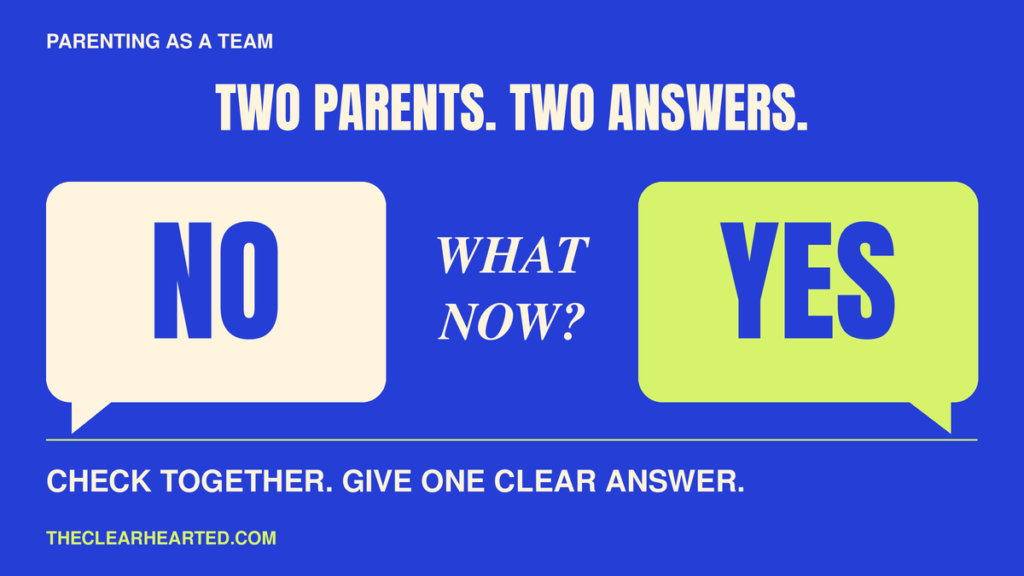
Keep your voice calm and the explanation short: “We gave you two different answers. Dad and I are going to check together, and then we’ll tell you the plan.”
You have not blamed either parent or made your child solve the disagreement. You have shown that the adults will handle it.
If there isn’t time for a private discussion—you’re walking out the door, for example—use the answer you had already given as the temporary plan: “We’re keeping the first answer for now. We’ll talk about it later.” You and your husband should agree on this default at another time, rather than announcing it as a new rule during a fight.
Avoid “Ask your dad, since he apparently makes the rules,” however satisfying that might sound in the moment. It hands the child an adult conflict to carry. You can be direct with your spouse later without asking your child to take your side.

Three things to say after bedtime
Once the children are elsewhere, describe the moment rather than his whole character.
1. Name what happened. “I had already said no to another episode. When you said yes in front of her, we gave her two answers.”
2. Explain the effect. “I felt undermined, and she had to figure out which parent to follow. I don’t want her stuck in the middle of that.”
3. Ask for a next-time agreement. “If you think my answer should change, can you ask me privately first? I will do the same when you have already answered.”
This is more useful than “You always make me the bad guy,” even if that is how the pattern feels. It gives him one event he can recognize and one behavior he can change.
If you need to discuss whether your first answer was fair, do it too. Being on the same team does not require one parent to agree with every rule the other makes.
Agree on the default before the next question
Children ask for decisions all day. You cannot hold a summit for every snack. Agree on a simple rule for moments when one parent has already answered:
“If either of us has said yes or no, the other will check before changing it. If we can’t check, the first answer stands until we talk.”
Then decide which topics need an advance conversation: screen time on school nights, bedtime, sleepovers, spending money, or discipline. A short shared plan for two recurring flashpoints is easier to use than a 30-page parenting constitution.
One workable version sounds like this: “On school nights we stop screens at eight. Either of us can make an exception for a special event, but we agree on it together first.” The details are yours to choose. The point is that your child isn’t watching you negotiate authority every evening.
When the adults disagree about a bigger issue, put it on a later agenda rather than trying to settle it while your child is waiting in the doorway.
If he says you are too strict
Ask which rule he wants to change and why. “Do you think eight is too early every night, or was tonight different?” A specific answer gives you something to discuss. “You’re too strict” on its own does not.
Be willing to hear his view. Perhaps the child had finished homework early, or perhaps he believes the screen rule no longer suits their age. Neither point requires him to reverse your answer without speaking to you.
Try: “I’m open to changing the rule with you. I need us to decide it as parents, not by contradicting each other in front of her.”
This also works in the other direction. If you think he makes too many exceptions, discuss the exceptions themselves. You do not need to make one parent the villain to set a shared limit.
If you were the parent who changed the answer
The same standard applies to you. Maybe he said yes to a late visit when you knew the child needed sleep. You may have had a good reason to object. You can still say, “I should have checked with you before changing your answer in front of him. Next time, let’s step aside first.”
An honest repair makes it easier to ask for one. It turns the conversation from “Which of us is the better parent?” into “How do we handle different information without leaving our child between us?”
If one parent repeatedly uses “But Mom said…” or “But Dad said…” to win the point, that is a separate pattern to address. Focus on how to stop it rather than rehearsing every past incident at once.
What to tell the child afterward
Your child may already understand that you disagreed. A brief explanation is enough: “We gave different answers earlier. That was for us to sort out. We talked, and the plan tonight is one episode.”
If the original no remains in place, say that plainly. If you agree to change it, say that too. Try not to ask the child which answer they liked better or explain why one parent was wrong. Their job is to be a child, not to referee your marriage.
If the disagreement became loud, you can add, “It wasn’t your fault we argued.” Then show repair through how you speak to each other next, not through a long explanation of adult tension.

What if it keeps happening?
Once can be a misunderstanding. A recurring pattern deserves its own conversation. Notice when it happens: only with screens, whenever one parent sets a limit, or especially when other people are watching?
Try one concrete boundary: “I won’t negotiate our disagreement through the kids. If we give different answers, I want us to step aside before either of us promises anything.” If that boundary is ignored repeatedly, the issue may be whether your judgment is respected as a parent, not simply the bedtime rule.
Outside support can help when both adults want to change a stuck pattern. If disagreements involve intimidation or fear, seek support for yourself from someone safe rather than treating it as a normal parenting debate.
Questions parents often ask
Should the first parent always have the final say?
No. Using the first answer as a temporary default prevents an instant contest. It does not make that parent’s decision permanently correct. Revisit the rule together later.
What if my child asks the other parent after I already said no?
Have the second parent say, “What did Mom say?” or “What did Dad say?” and check with you if new information matters. The goal is a clear answer, not a test of loyalty.
Should we tell our child we disagreed?
You do not have to pretend both parents always think alike. A simple “We had different ideas and worked it out” models a useful skill without pulling the child into the details.
The win is not that one of you says yes less often. It is that your child sees two adults who can differ without asking them to choose a side.
Clearhearted publishes general educational content about relationships and parenting. It is not therapy, counselling, medical, or legal advice and cannot account for your specific situation. See our Disclaimer.