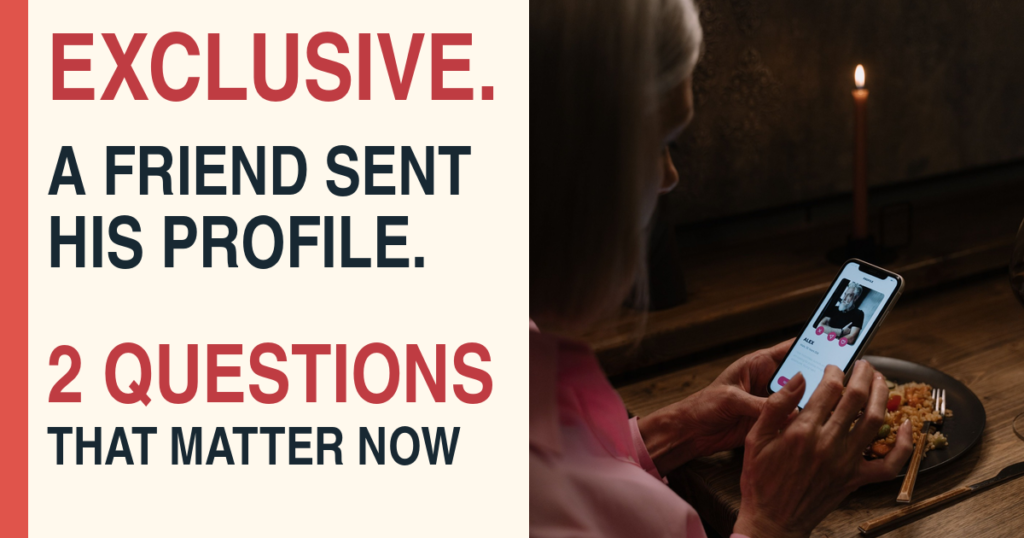
You thought the conversation was clear. You both said you were exclusive. Then a friend sent you a screenshot of his dating profile. His photos were familiar. The profile was still there.
The temptation is to solve the entire relationship from that one screen: When was he last online? Did he change his bio? Who has he messaged? You may have none of those answers. A visible profile is a reason to ask a direct question; it is not, by itself, a record of what he did yesterday.
You can take the discovery seriously without turning yourself into an investigator. What matters now is the agreement you made, what he says it means, and how he responds when you bring this up.
First, remember what you actually agreed to
Did “exclusive” mean neither of you would date or message other potential partners? Did you also talk about deleting profiles? Some people assume the first includes the second. Others delete an app from their phone and do not realize their public profile may remain. That explanation may be true in a particular case; a screenshot cannot verify it.
You are allowed to have a preference even if the deletion rule was never spoken aloud. You can say, “I thought being exclusive meant we had both stopped using dating apps. I’d like to know how you understood it.” The aim is to make the agreement specific enough that you can both recognize whether you share it.
Research on agreements about exclusivity reinforces the value of discussing expectations rather than assuming two people mean exactly the same thing by one label. That study is about sexual exclusivity, not dating app profiles; it does not tell you what this screenshot means. The useful principle here is clarity about an agreement.
What a profile can and cannot prove

Photo by Andrea Piacquadio on Pexels.
A profile might remain visible after someone stops actively using an app. A person might also keep using an account while saying they are exclusive. The screen alone does not distinguish those possibilities. Nor is a single “active” indicator necessarily a trustworthy map of a person’s intentions; app interfaces and visibility rules vary.
If the screenshot is old, ask when it was taken. If your friend found the profile today, say that plainly. You do not need to gather five more screenshots to earn permission to have a conversation. One concrete observation is enough: “My friend saw your profile this week.”
Avoid calling it proof of cheating if you do not have evidence of contact or a meeting. You can still say it unsettled you. Your concern does not need a courtroom standard before it is worth raising.
Ask a question that can be answered
Choose a quiet moment instead of starting a fight through the app that brought you together. Keep the question short:
“We said we were exclusive. Your dating profile is still visible, and that surprised me. Are you still using the app? What did you understand our agreement to include?”
If you have a clear preference, include it: “I don’t want to be exclusive with someone who is still looking for dates. I’d like us both to close our profiles if we are making this commitment.” That states your terms without claiming to know his private activity.
Then let him answer. He may say he deleted the app and forgot the account; he may tell you he has been talking to people; he may reveal he thought “exclusive” meant something narrower. Those answers lead to different decisions. They are more useful than guessing from the color of a status dot.
Listen for clarity and follow-through
An answer you can work with is specific. “I haven’t used it since we agreed. I deleted the app, but I didn’t close the account. I’ll do that, and we can talk about what exclusive means to both of us.” You can decide whether you believe him; you can also watch whether the next step actually happens.
Another honest answer might hurt: “I’ve kept the option open because I’m unsure.” At least it tells you what decision is in front of you. You do not need to bargain someone into an exclusivity they do not want.
A vague answer keeps moving the subject. “Why are you checking on me?” may be a fair question if you have been tracking him. It does not answer whether he is using the profile. You can address both: “A friend showed me the page. I want to talk about the agreement we made.”
If he mocks you for asking, demands that you forget the screenshot, or changes the definition of exclusivity only after being confronted, pay attention to that response. The problem then includes how the two of you handle an uncomfortable fact, not only the profile.
Decide what you need instead of policing an app

You may want a straightforward shared agreement: no new matches, no conversations with people you might date, and profiles closed or paused. Another couple might agree on different boundaries. What matters is that the terms are mutual, understood, and freely chosen.
Do not make yourself the administrator of his account. Asking for a decision is reasonable; repeatedly checking whether a profile reappears can pull you into a role you never wanted. If trust only survives while you monitor him, it is worth asking whether the relationship is giving you the steadiness you need.
If he says he is not ready for the commitment you want, you can read our piece on what “I’m not ready for a relationship” can mean. The important thing is to take his present offer seriously, even if a warmer version was implied before.
If the two of you never explicitly agreed
Finding the profile may still sting. Perhaps you have spent every weekend together and assumed the relationship had moved beyond dating others. He may have assumed otherwise. Neither assumption creates a shared agreement on its own.
This is a good time to say what you want: “I enjoy seeing you, and I’m looking for an exclusive relationship. Is that what you want with me?” You can ask about the app as part of that conversation. You do not need to frame the question as a charge in order to ask for clarity.
If his answer is “not yet,” you get to decide whether continuing casually fits you. Your choice should reflect what is actually on offer, not an imagined deadline by which he will surely change his mind.
A calmer next step
Write down the agreement as you understood it and one question you want answered. Have the conversation once. Afterwards, judge the combination of words, practical action, and the way he treated your concern. A profile can be closed in minutes. Trust is rebuilt through honesty and consistency over longer than that.
Does a visible dating profile mean he is cheating?
No single screenshot can establish that. It can justify asking whether he is using the account and whether your exclusivity agreement still stands.
Should I ask to see his messages?
You can explain what would help you feel able to continue. Demanding a full inspection may create more conflict without settling the question of trust. Decide which information you actually need to make your own choice.
What if he deletes it immediately but I still feel uneasy?
Name the part that remains unresolved: Was there a different understanding of exclusivity? Did he avoid a direct answer? Do you need time? Deleting an account is a step, not an obligation for you to feel reassured on command.
You do not have to ignore the profile. You also do not have to let it turn every evening into a search. Ask for clarity, then decide whether the relationship he describes is the one you agreed to be in.
Clearhearted publishes general educational content about relationships. It is not therapy, counselling, or medical advice, and it cannot account for your specific situation. See our Disclaimer.


Conversation
Comments are closed.