He mentioned a colleague twice. Nothing happened, nothing was said, and you spent the rest of the evening at half-attention, running something in the background.
Then comes the second layer, which is often worse than the first: the feeling that being jealous at all means something is wrong with you.
There are two kinds, and they behave differently
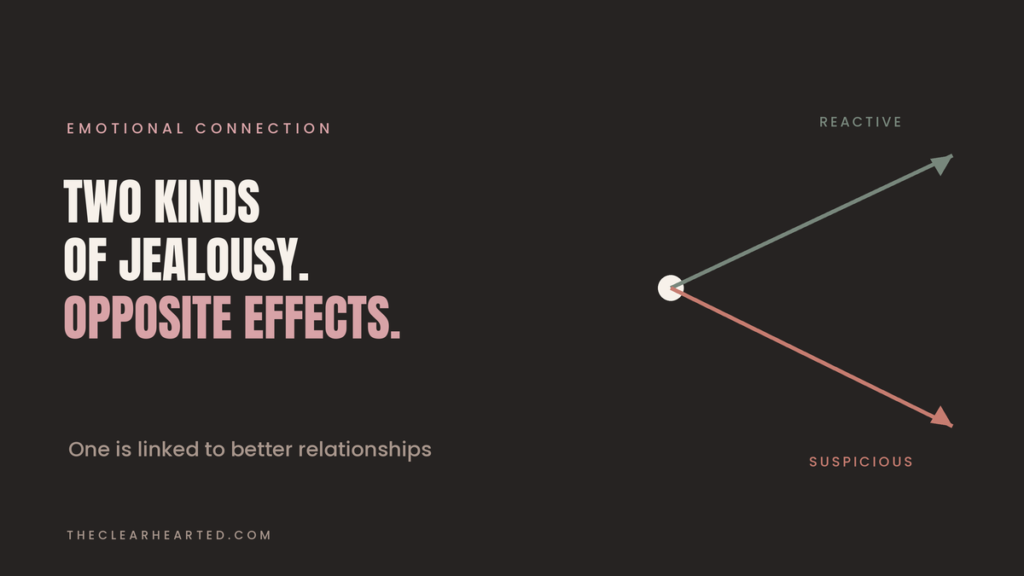
Researchers stopped treating jealousy as one thing decades ago. Buunk, and later Rydell and Bringle, separated it into two dimensions that turn out to have almost opposite associations.
Reactive jealousy is the emotional response to something that actually happened — a partner flirting, a boundary crossed, real evidence of a threat.
Suspicious jealousy is the thinking-and-checking kind: obsessive thoughts and monitoring behaviour in the absence of any serious threat.
Across a body of research including studies of around a thousand couples, the two produced opposite results. Reactive jealousy was associated with higher relationship quality, greater trust, and more love. Suspicious jealousy was associated with lower relationship quality, insecurity and lower self-esteem.
Key takeaway
Feeling jealous when something actually happened isn’t a flaw — the research links it to better relationships, not worse. The damaging version is the one that runs without a trigger.
That reframe matters, because most advice tells you to eliminate jealousy entirely. The evidence suggests you’d be removing something that functions as a signal.
Which one is yours?
How to tell them apart
Ask what set it off. Reactive jealousy has an answer you could say aloud without embarrassment — he left with her and didn’t mention it. Suspicious jealousy struggles to name a trigger, and the honest answer is closer to nothing, exactly.
Second test: what do you want to do about it? Reactive jealousy wants to say something. Suspicious jealousy wants to check something.
That second test is the sharper one, and it points at the behaviour that does the actual damage.
Why checking makes it worse
Surveillance behaviour — reading messages, tracking location, scrolling someone’s followers — is the defining feature of the harmful type, and it fails for a specific reason.
Checking cannot produce reassurance. Finding nothing doesn’t prove there’s nothing; it proves you didn’t find it this time. So the relief lasts about an hour and the threshold for the next check drops.
Checking is designed to end uncertainty and reliably produces more of it.
It also costs you something separate from the anxiety. Trust isn’t only something you receive — it’s something you do, and monitoring is the practice of not doing it.
What to do with reactive jealousy
Something happened. Say it, once, small and specific.
When you left with her without saying, I didn’t love it.
Not an accusation, not a request for a defence. A description. The research linking reactive jealousy to higher relationship quality makes more sense in this light — it’s information being passed between two people, which is what a functioning relationship does with a signal.
What to avoid is the delayed version, where you say nothing for three weeks and then deliver it as a case with evidence attached.
What to do with the suspicious kind
Don’t check. Not once. Every check strengthens the loop and teaches you that the anxiety is worth obeying.
Name it as a feeling, not a finding. I’m feeling insecure tonight and I don’t think it’s about anything you did. This is a hard sentence and an unusually effective one, because it asks for closeness instead of a defence.
Notice when it arrives. Suspicious jealousy tends to track your state rather than his behaviour — worse when you’re tired, after a bad week, when something else feels precarious. If it peaks on Sunday nights, it isn’t about him.
Don’t ask for repeated reassurance. It works for an evening and raises the dose needed next time. The same mechanism as checking, outsourced.
What to do next
For one week, write down each time jealousy arrives and what triggered it. Most people find that most entries have no trigger — and seeing that written down does more than any amount of telling yourself to stop.
When it’s about the relationship, not you
One honest complication. Suspicious jealousy is defined as occurring without serious threat — but sometimes the threat is real and simply undisclosed, and the vigilance is your own pattern-recognition working correctly.
The test isn’t whether you feel it. It’s whether the feeling is specific. Vague dread that attaches to whoever is nearby is usually about you. Persistent unease about one particular person, one recurring gap in the account, one thing that never quite adds up — that’s different, and it deserves a direct question rather than surveillance.
And if you find you’re doing all the interpreting because he doesn’t say much, that’s a separate problem — see how to know if he’s emotionally unavailable.
If this is your situation
If jealousy is affecting your sleep, your work, or your ability to enjoy the relationship at all, that’s worth taking to a licensed therapist. Persistent jealousy responds well to treatment and no article is a substitute for it. If a partner monitors your messages or movements, that’s a different situation entirely — please contact a domestic violence support service in your country.
Clearhearted publishes general educational content about relationships. It is not therapy, counselling, or medical advice, and it cannot account for your specific situation. See our Disclaimer.