He’s sorry. He seems genuinely sorry. And you have no idea whether that means anything, because he was sorry last time too.
Most advice on this is useless in opposite directions — either everyone deserves a second chance, or once a liar always a liar. Neither helps, because both skip the actual question.
The apology tells you nothing
Start here, because it’s where most decisions go wrong.
People are judging remorse by how sorry someone seems — the tone, the tears, the words. But being sorry is easy and costs nothing. Some of the most convincing apologies come from people who have had the most practice giving them.
Key takeaway
Remorse is a feeling. Change is a behaviour. Only one of them can be observed, and it can only be observed later.
Which means the decision cannot be made in the conversation where he apologises. That’s the hardest part, because that conversation is exactly when it feels most urgent to decide.
Four questions
1. Is this the first time, or the first time you found out? Different things entirely. A single lapse and a sustained pattern that ended when it was discovered require different responses, and people frequently confuse them because the discovery felt like a single event.
2. Did he tell you, or did you find out? Someone who brought it to you is doing something structurally different from someone who was caught. Not automatically better as a person — but it’s real information about whether the truth arrives on its own.
3. Can he describe the effect on you without prompting? This is the sharpest of the four. Ask what he thinks it was like for you. Someone who has genuinely thought about it can answer. Someone focused on their own guilt will talk about how bad they feel, which is a different subject wearing similar clothes.
4. Has he named what changes, specifically? “I’ll do better” is nothing. “I’m going to stop going for drinks after work on Thursdays” is something — it has a shape, and you’ll know within a month whether it happened.
Mistake or pattern
The whole decision usually reduces to this, and it’s answerable.
How to tell them apart
A mistake is out of character, acknowledged fully, and followed by visible change. A pattern is: it’s happened before in some form, the explanation includes what you did to contribute, and the change lasts about three weeks.
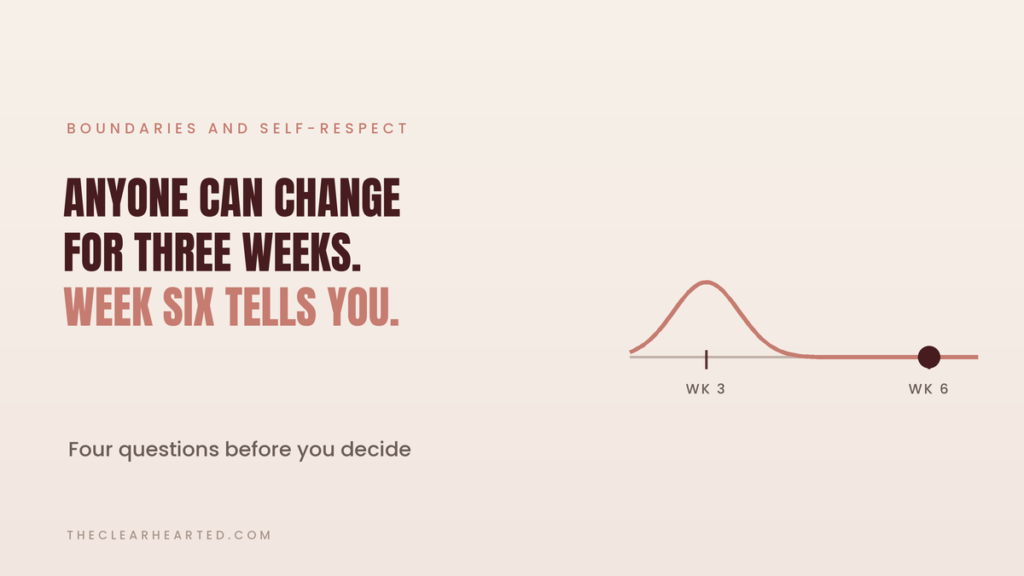
The three-week thing is worth knowing. Almost everyone can sustain changed behaviour for three weeks. It’s week six that’s informative.
What a real second chance looks like
Giving one is legitimate. Giving one badly is what causes the damage.
Decide on a timeframe, privately. Six weeks, three months, whatever fits. Not as a threat — so that you’re not re-deciding daily. Constant re-evaluation is exhausting and it’s how people end up two years in without ever having chosen.
Name the specific thing you’re watching. To yourself if not to him. Vague vigilance turns into surveillance, and surveillance is corrosive regardless of what he does.
Don’t pretend it didn’t happen. Forgiveness isn’t amnesia. You’re allowed to say it’s still there.
Don’t make him pay for it indefinitely. A second chance where he’s punished for a year isn’t a second chance, it’s a longer ending. If you can’t stop bringing it up after several months, that’s information about whether you actually forgave it.
What to do next
Don’t decide tonight. Write down the one specific thing that would need to be different in six weeks, and the date. Then live normally until then. Deciding in advance is the only way to avoid deciding while flooded.
When not to
Some things aren’t second-chance situations, and it’s worth saying so plainly rather than leaving it implied.
If the account of what happened keeps changing. If you’re being told your memory of it is wrong. If the apology arrives with a bill attached — what you did to cause it. If it’s the third time and each previous time came with the same words.
And one that’s easy to miss: if you find you can’t raise it without it becoming a conversation about how you’re handling it, the second chance has already been converted into something else. What to say when he gets defensive covers that mechanism.
If this is your situation
Anything involving intimidation, threats, or being made to doubt your own account of events is not a second-chance decision and shouldn’t be treated as one. Please contact a domestic violence support service in your country. If you are in immediate danger, contact your local emergency services.
The part nobody says
You are allowed to not give one, for a thing that other people would forgive.
There’s no objective threshold above which leaving becomes reasonable. If something changed how you feel and it hasn’t changed back in months, that’s sufficient. You don’t need it to be bad enough to explain to a jury.
Clearhearted publishes general educational content about relationships. It is not therapy, counselling, or medical advice, and it cannot account for your specific situation. See our Disclaimer.


Conversation
Comments are closed.