It’s the fifth time. Maybe the fiftieth. The subject is the dishes, or his mother, or how much you spend on things he thinks are unnecessary. And somewhere in the second minute you both realise you have been here before, saying these exact sentences, in this exact order.
The conclusion most people draw is that something is broken. Either he won’t listen, or you’re not explaining it right, or the relationship has a fault line that keeps splitting open.
The research points somewhere less alarming and much more useful.
The number that reframes the whole thing
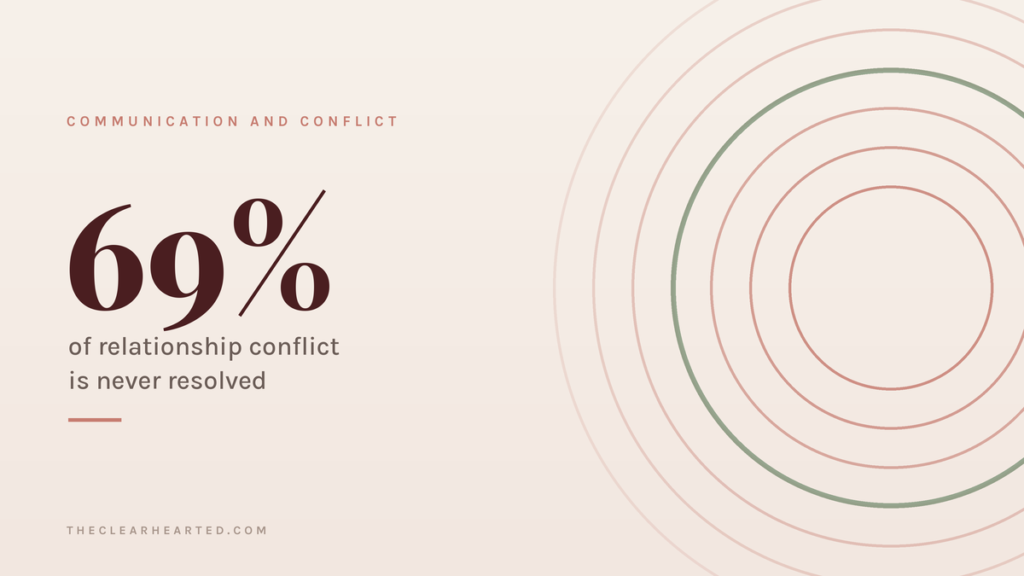
John and Julie Gottman have studied couples for decades, following some of them for twenty years. One of their most repeated findings is this: roughly 69% of relationship conflict is about perpetual problems — disagreements that never get resolved.
Not resolved slowly. Not resolved with better communication. Not resolved at all.
Perpetual problems come from fundamental differences in personality or lifestyle needs. One of you is a saver, the other a spender. One recharges alone, the other recharges with people. One wants the weekend planned, the other wants it open. These aren’t misunderstandings. They’re two people who are actually different.
Key takeaway
Happy couples and unhappy couples have the same number of perpetual problems. The difference isn’t whether the argument recurs. It’s what happens while it recurs.
That last point is the one worth sitting with. If recurring arguments were the problem, couples who were happy after twenty years wouldn’t have any. They do. They have the same argument you have, and they’ve had it for two decades.
Why trying to solve it makes it worse
Here is the trap. Because the argument keeps returning, both people assume it must have a solution they haven’t found yet. So each round becomes another attempt to win — to finally produce the argument, the example, the piece of evidence that makes the other person concede.
Nobody concedes, because there’s nothing to concede. He isn’t wrong for needing quiet. You aren’t wrong for needing plans.
What happens instead is that each failed round adds to a growing sense that something is fundamentally wrong — with him, with you, or with the relationship. The Gottmans call this state gridlock. The conversation stops moving. Both people harden into positions. Curiosity disappears and only defence is left.
Gridlock is the actual danger, not the recurrence. A perpetual problem discussed with affection for twenty years is a quirk. The same problem in gridlock for two years is corrosive.
How to spot gridlock
You can predict his sentences before he says them. You feel rejected rather than disagreed with. Neither of you asks questions anymore, because you both think you already know the answers. Afterwards you feel further apart rather than merely tired.
What’s actually underneath
Perpetual problems are rarely about their surface. The argument about money is usually about security, or freedom, or what it felt like growing up without either. The argument about weekends is about whether rest means recovering alone or recovering together.
The Gottman approach to gridlock is to stop negotiating the surface and get curious about what sits under each position. Not to agree with it. To understand it well enough that it stops seeming unreasonable.
This is slower and less satisfying than winning. It’s also the only move that has ever worked on a problem that cannot be solved.
What to do instead
Name it out loud as recurring. Something like: We’ve had this argument a lot. I don’t think either of us is going to convince the other. Can we try a different version of it? That single sentence changes the goal in the room from winning to understanding.
Start soft or don’t start. Gottman’s research on how conversations open is blunt: the first three minutes largely predict the rest. You never help with anything and I feel overwhelmed by the house this week are about the same subject and produce completely different conversations.
Ask one question you don’t know the answer to. Why does this particular thing matter so much to him? Not rhetorically. If you can already recite his answer, you’re not asking, you’re prosecuting.
Aim for a workable arrangement, not agreement. You can decide who does what on which nights without either of you changing your mind about whose standard is correct. Most perpetual problems can be managed practically long before they’re understood emotionally.
What to do next
Before the next round, decide what a good outcome would be if he never changes his mind. If you can’t answer that, the conversation you’re planning is an attempt to win, and it will go the way the last four went.
When it isn’t a perpetual problem
Not every recurring argument belongs in this category, and it matters not to file the wrong thing here.
Perpetual problems come from differences. If the argument recurs because he agreed to something and then didn’t do it, that isn’t a difference in personality — that’s a broken agreement, and it has a solution. Repeatedly treating a broken agreement as an unsolvable difference is how people talk themselves into accepting things they shouldn’t.
The test is simple. Ask whether you’re arguing about who each of you is, or about whether something he said he’d do got done. The first is perpetual. The second isn’t, and it deserves a clear boundary rather than more understanding.
And if the argument recurs because raising anything at all leads to him withdrawing entirely, that’s a different pattern with its own dynamics — covered in why he pulls away when things are going well.
If this is your situation
If raising a subject is met with intimidation rather than disagreement, or if you have stopped bringing things up because of what happens when you do, that is a different situation and it deserves proper support. Please contact a domestic violence support service in your country. If you are in immediate danger, contact your local emergency services.
The short version
Most of what you argue about will still be there in ten years. That sounds bleak and isn’t. The couples who last aren’t the ones who ran out of disagreements. They’re the ones who found a way to have the same disagreement without it costing them anything.
Clearhearted publishes general educational content about relationships. It is not therapy, counselling, or medical advice, and it cannot account for your specific situation. See our Disclaimer.


