You apologised. You meant it. You even used the phrasing you’d read about — named the thing, didn’t say “but”, didn’t make excuses.
And it changed nothing. He was still cold that evening, and you’re left assuming you said it wrong.
The research suggests you probably didn’t.
The finding that contradicts most advice
John Gottman’s team studied what they call repair attempts — any word or gesture meant to de-escalate a conflict. Across more than 3,000 couples, they found something unexpected.
How the repair was made did not predict whether it worked. Some people made beautifully constructed repairs that their partner simply couldn’t hear. Others made clumsy, graceless attempts that landed perfectly.
What separated the couples who recovered from those who didn’t wasn’t the skill of the person apologising. It was whether the other person could receive it.
Key takeaway
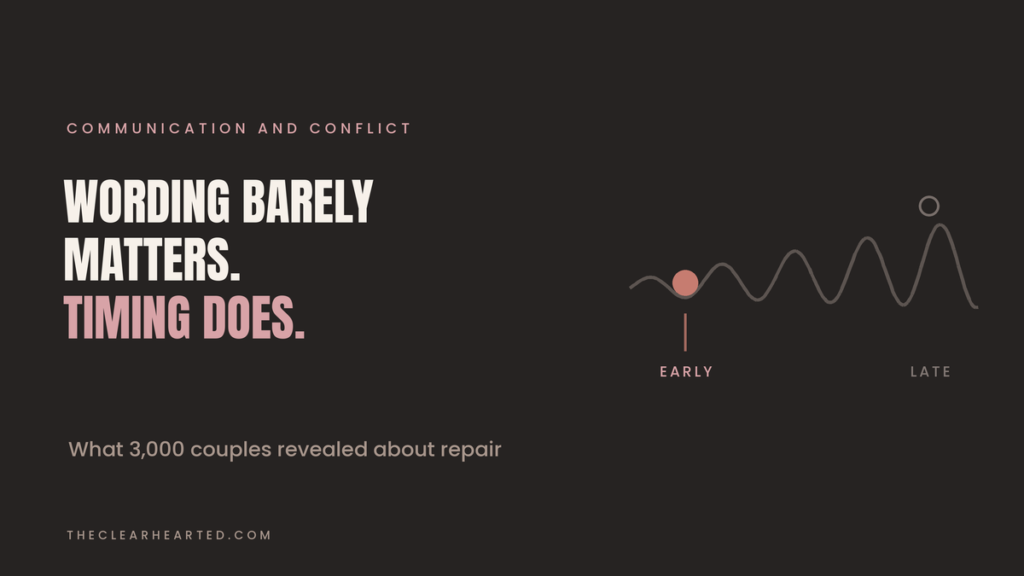
Every apology article optimises your wording. The research says wording is close to the least important variable. Timing and the emotional climate you’re apologising into matter far more.
That’s freeing and slightly deflating at once. You can stop searching for the perfect sentence. You also have to accept that a perfect sentence wouldn’t have saved you.
Why timing beats wording
Gottman’s research on flooding found that once heart rate passes roughly 100 beats per minute, the capacity to take in what someone is saying drops sharply. A person in that state literally cannot process a repair, however well phrased.
Which explains the most common failure: apologising at the peak. You wait until it’s very bad, then deliver your careful apology to someone whose nervous system has stopped receiving.
The Gottman guidance is blunt — repair early and repair often. A small move in the first two minutes does more than an eloquent one twenty minutes in.
A clumsy repair at minute two beats a beautiful one at minute twenty.
What an early repair looks like
Not a formal apology. Something much smaller, deployed while things are still recoverable.
- Can we start that again?
- That came out worse than I meant it.
- I’m getting wound up. Give me a second.
- You’re right about that part.
- A hand on his arm, without words
- I don’t want to fight about this.
None of these are impressive. That’s the point — they cost almost nothing and they interrupt the escalation before it needs a real apology.
When a proper apology is needed
For something that actually landed badly, three things matter — and notice that none of them is elegance.
Name the specific thing. Not “I’m sorry you were upset.” I’m sorry I brought that up in front of your sister. Specificity is what proves you understood.
Acknowledge the effect, not just the act. That would have been humiliating. The research on emotional repairs — taking responsibility, showing empathy — found them consistently more effective than cognitive ones that explain and justify.
Stop. No context, no explanation of what you’d meant, no reference to what he did. Everything after the apology dilutes it.
What to do next
Practise repair on something trivial this week — a mildly sharp tone about the dishwasher. That was snappy, sorry. Couples who build the habit on small frictions have it available during large ones. Nobody develops it mid-crisis.
The other half nobody mentions
If acceptance is what predicts outcomes, then receiving repairs is a skill too — and it’s yours as much as his.
Accepting a repair doesn’t mean the issue is settled or that you agreed. It means letting the temperature drop. Okay. Thank you. is a complete response, and it can be followed by returning to the subject an hour later.
The instinct to reject a clumsy repair — because it wasn’t good enough, because he doesn’t really get it — is understandable and expensive. In Gottman’s lab, couples whose repairs were consistently rejected fared markedly worse than couples with the same amount of conflict and reliable acceptance.
How to spot a repair being offered
They’re easy to miss because they arrive badly disguised — a joke at the wrong moment, an abrupt change of subject, a hand on your back, an offer of tea. Mid-argument, these look like avoidance. Often they’re an attempt to stop the fall.
When repair can’t land
The research also found the climate matters. Where there’s accumulated resentment, repairs stop registering — the same words that worked two years ago now read as manipulation. That’s not a wording problem either, and no phrasing fixes it.
And there’s a version worth naming plainly. An apology that arrives reliably, changes nothing, and is followed by the same behaviour next month isn’t a repair. It’s a mechanism for ending conversations. The tell is simple: does anything differ afterwards, or only the temperature?
If your apologies land but his never come, that imbalance is its own subject — see signs you’re the only one maintaining the relationship.
Clearhearted publishes general educational content about relationships. It is not therapy, counselling, or medical advice, and it cannot account for your specific situation. See our Disclaimer.



Conversation
Comments are closed.