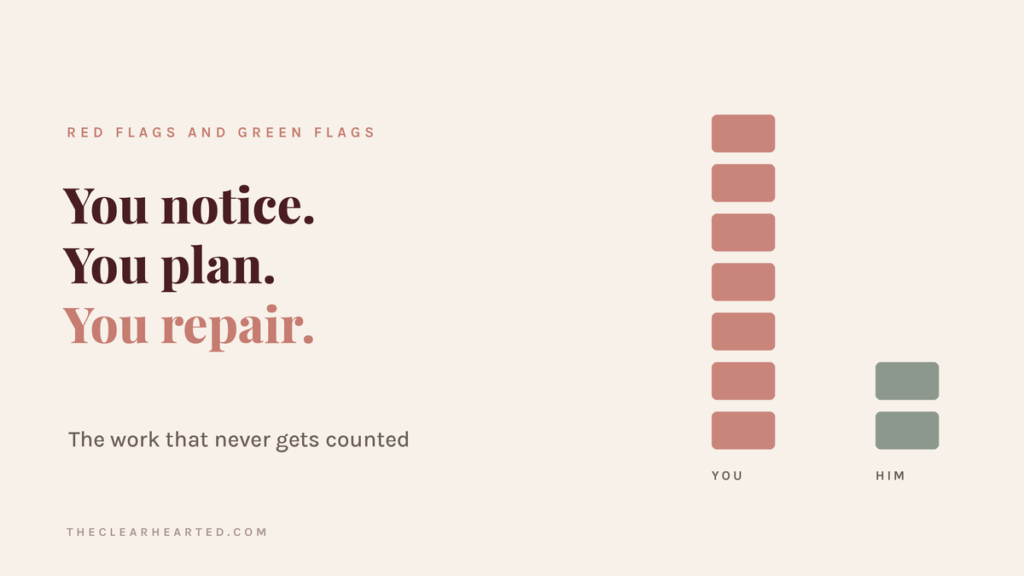
You booked the table. You remembered his mother’s birthday. You noticed things had gone quiet between you and started the conversation about it. You planned the weekend, and when it went wrong you were the one who repaired it afterwards.
If you tried to describe this as a problem, it would sound like you were complaining about being organised.
The work has a name and it’s been measured
In 2019 the sociologist Allison Daminger published a study in the American Sociological Review based on interviews with 35 couples. She argued that household labour has a dimension most research had ignored: not the physical tasks, but the thinking behind them.
Daminger identified four phases of what she called cognitive labour: anticipating a need before it becomes urgent, identifying the options, deciding between them, and monitoring whether it actually happened.
Two findings matter here. Decision-making was the phase most likely to be shared. Anticipation and monitoring \u2014 the two least visible phases \u2014 fell disproportionately on women. And this held even in couples who described their division of labour as equal.
Key takeaway
The parts of the work that get shared are the visible ones. The noticing and the checking stay with one person, and because nobody sees them, nobody counts them \u2014 sometimes including the person doing them.
Daminger studied households. Relationships have their own version of the same structure, and that extension is my observation rather than her finding \u2014 but the shape transfers cleanly. Someone has to notice the relationship needs attention. Someone has to decide what to do about it. Someone has to check whether it worked.
Seven signs it’s landing on you
1. You start every difficult conversation. Not because you enjoy it. Because if you don’t, it doesn’t happen, and the thing just sits there.
2. You do the repairing. After friction, you’re the one who comes back, names it, and closes the gap. He waits for it to pass.
3. You hold the calendar for both of you. His mother’s birthday, the friend’s wedding, the fact that you haven’t seen anyone in a month. You’re running the anticipation phase alone.
4. Nothing gets planned unless you plan it. He enjoys the weekend. He didn’t think of it.
5. You notice the temperature and he doesn’t. You can tell when things have gone flat. He is genuinely surprised when you say so.
6. You manage his relationships. Reminding him to call his brother, smoothing things with your friends on his behalf, remembering what he’s supposed to remember.
7. You feel alone in it while being told everything is fine. Because from where he stands, it is fine. That’s what carrying it looks like from the other side \u2014 it looks like nothing happening.
How to spot it in a week
For seven days, note every time you notice something the relationship needs \u2014 a conversation, a plan, a repair, a reminder. Don’t act differently, just count. Most people are surprised by the number, and the number is the argument.
Why “just ask him” usually fails
The standard advice is to delegate. It rarely works, and Daminger’s framework explains why: asking him to do a task hands over the execution while you keep the anticipation and the monitoring.
You still noticed it needed doing. You still have to check it got done. You’ve given away the visible part and kept both invisible parts, which is why delegating can leave you more tired rather than less.
The thing worth handing over isn’t the task. It’s the noticing.
How to raise it
Describe the category, not the incidents. A list of examples invites him to dispute each one; a description of the pattern doesn’t.
I’ve realised I’m the one who notices when we need to talk, when we need to see people, when something’s off. I don’t want to be the only one holding that. Can you take some of the noticing, not just the doing?
Then give it something concrete to attach to. Ownership of one whole area \u2014 all of it, including remembering it exists \u2014 works better than a list of tasks. Not “book the restaurant” but “our plans with other people are yours now.”
What to do next
Pick one area and hand over the whole thing, noticing included. Then \u2014 the hard part \u2014 don’t check on it for a fortnight. If you monitor it, you’ve kept the invisible half and nothing has actually changed.
What his response tells you
Some men genuinely have not seen it. Invisible work is invisible in both directions, and Daminger found it often goes unnoticed by the person doing it too. A first reaction of surprise isn’t necessarily defensiveness.
What matters is the month after. Does the noticing start to shift, or does it come back to you the moment attention lapses? One conversation changes awareness. Only repetition changes a pattern.
And if raising it produces a version where you’re told you’re controlling for wanting shared responsibility, that’s worth reading about separately \u2014 the difference between a boundary and an ultimatum covers that move directly.
The short version
What you’re carrying is real, it has a name, and it has been measured. You are not imagining it and you are not being difficult for noticing it.
The goal isn’t to stop caring about the relationship. It’s to stop being the only person whose job that is.
Clearhearted publishes general educational content about relationships. It is not therapy, counselling, or medical advice, and it cannot account for your specific situation. See our Disclaimer.