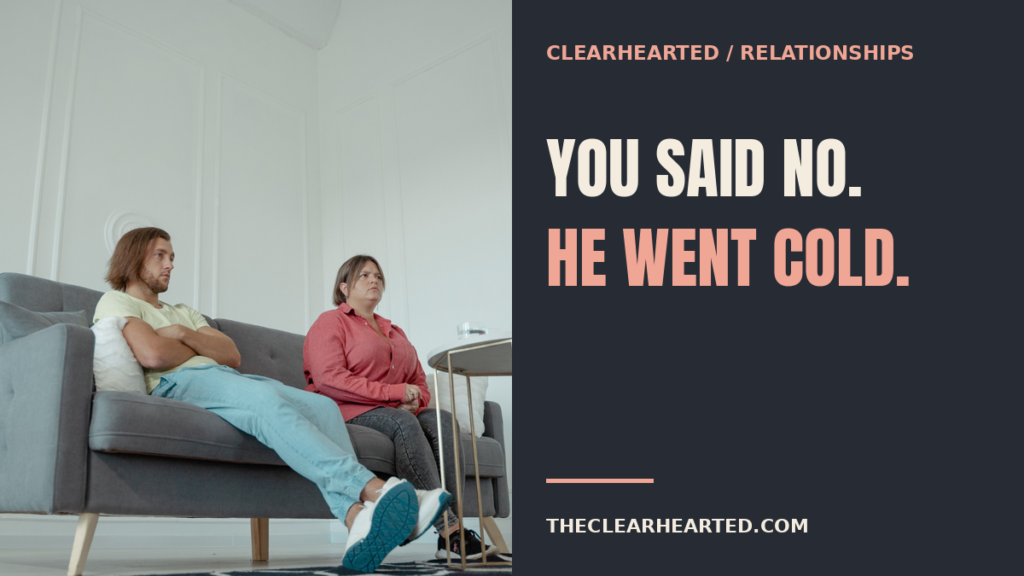
You said, “Not tonight.” He rolled away, went quiet, and was barely warm the next morning. Maybe he was disappointed. Maybe he needed a little time with his feelings. But if kindness disappears whenever you say no, it can start to feel as though affection has a condition attached.
When he goes cold when you say no to intimacy, you do not need to solve his feelings by changing your answer. Your no can stand on its own. The useful work is to tell the difference between a brief, respectfully expressed disappointment and a repeated response that makes you afraid to say no next time.
A person can feel disappointed and still respect you
Being turned down can sting, even in a loving relationship. A partner might need a moment or say, “I was hoping we’d be close tonight. I’m a little disappointed, but I understand.” That is a feeling, not a demand. He can also ask whether you would like to cuddle or spend time together another way, provided your answer is respected.
The difference is what happens after he hears no. Does he stay kind? Does he make space for you without insisting you explain yourself until he approves? Or does he withdraw ordinary affection, accuse you of not loving him, and keep asking until you give in? The repeated pattern matters more than guessing what he privately intended on one evening.
No one is entitled to physical intimacy because they are dating you, have done something nice, or were intimate with you before. You are allowed to change your mind. He is allowed to have feelings about a mismatch; he is responsible for how he handles them.
How to name what happened without apologizing for your no

Talk at a time when neither of you is expecting intimacy. Try:
“When I said no last night, you stopped speaking to me and were
distant this morning. I need to be able to say no and still feel treated
kindly. Can we talk about how we both handle disappointment?”
You are not demanding that he feel cheerful. You are asking him to separate his feelings from his treatment of you. If he says he needed space, ask what respectful space would look like: “You can say you need an hour. Going silent for the rest of the day leaves me guessing whether I’m being punished.”
If he replies, “So I’m not allowed to be upset?” say, “You are allowed to feel upset. I am talking about what happens between us after I say no.” Then let his answer show whether he can stay with that distinction.
Four things to notice before you blame yourself
1. Is the distance brief and explained? “I’m disappointed and I need a little quiet” is different from unexplained coldness that lasts days.
2. Does he keep asking after you decline? Repeating the request, bargaining, or listing what he has done for you can make a supposed choice feel like a test you must pass.
3. Does normal care return only if you change your mind? If affection comes back after you agree, but not when you hold your boundary, notice the connection without arguing about what was in his head.
4. Can you say no without planning how to manage his reaction? If you rehearse excuses or agree to avoid the fallout, the cost of saying no has become part of the problem.
One hard night does not tell you everything. A pattern that makes you feel unable to refuse deserves careful attention and outside support.
You do not need a better excuse
“I’m tired” and “I don’t want to” are both complete reasons. You can explain more when you want to, but an explanation should be an invitation to understand you, not a ticket you must present to make your refusal valid.
Some couples deal with different levels of desire. That is a real issue worth discussing with care, outside a moment of pressure. You might talk about what helps each of you feel close, how to invite intimacy without making assumptions, and what affection can look like when sex is off the table. A mismatch can be difficult without either person becoming the villain.
But a long conversation about desire cannot replace respect for a specific no. If the next sentence is “You owe me because we haven’t in two weeks,” the immediate issue is pressure, not scheduling.
What a respectful response can sound like
“Okay. Thanks for telling me.” “Would you like some space or a hug?” “I’m disappointed, but I don’t want you to feel pressured.” A partner does not need to use a perfect script. These examples show the principle: your answer is accepted, and ordinary kindness remains.

Source: RDNE on Pexels
Your version might be: “I want to feel close to you, and tonight that means talking and sleeping.” He can tell you what he feels without treating your no as a debt. If the two of you can have that conversation, you have something to work with.
If he agrees in the daytime but goes cold again the next time, treat the repeated behavior as information. You are allowed to decide that this pattern is not acceptable for you, even if he says he did not mean it as punishment.
The early version of this pattern can look charming until you refuse a smaller request. He Was Charming Until You Said No explores what to notice when someone reacts badly to a boundary.
It may help to agree on a different way to end the evening when one of you wants closeness and the other does not. Perhaps you say goodnight, share a hug if both want one, and leave the larger conversation for the next day. That small ritual will not solve a persistent pressure problem, but it can help a couple who both want to be considerate and have been fumbling through disappointment. The measure is whether you can still choose freely, not whether the ritual looks affectionate from the outside.
When to seek more support
If you feel pressured, frightened, or coerced, or if he retaliates when you refuse, consider telling someone you trust and contacting a sexual assault or relationship support service. RAINN’s guide to consent explains that consent should be voluntary and free of pressure or fear. The related RAINN guide to intimate partner sexual violence discusses pressure, guilt, threats, and retaliation. These resources can help you think through your own situation; an article cannot diagnose it for you.
If it is unsafe to raise the subject directly, you do not need to deliver a speech to him first. Make contact with a trusted person in a way that is safe for you. Your safety matters more than producing the right sentence.
The part you are allowed to keep simple
You can care about his disappointment and keep your no. Both can be true. If he goes cold when you say no to intimacy, describe the behavior, ask for a respectful way to handle feelings, and pay attention to what changes the next time. A relationship should have room for your honest answer, even when it is not the answer he hoped for.
Quick questions
Should I apologize for saying no? You can acknowledge that he feels disappointed without apologizing for having a boundary.
What if he says the silence was accidental? Ask for a clearer way to communicate next time, then observe whether that happens.
What if I have already said yes just to avoid his reaction? That matters. You deserve support without judgment; speak with someone you trust or a relevant support service if you can do so safely.
Clearhearted publishes general educational relationship content. This article cannot assess your specific situation or replace professional support.