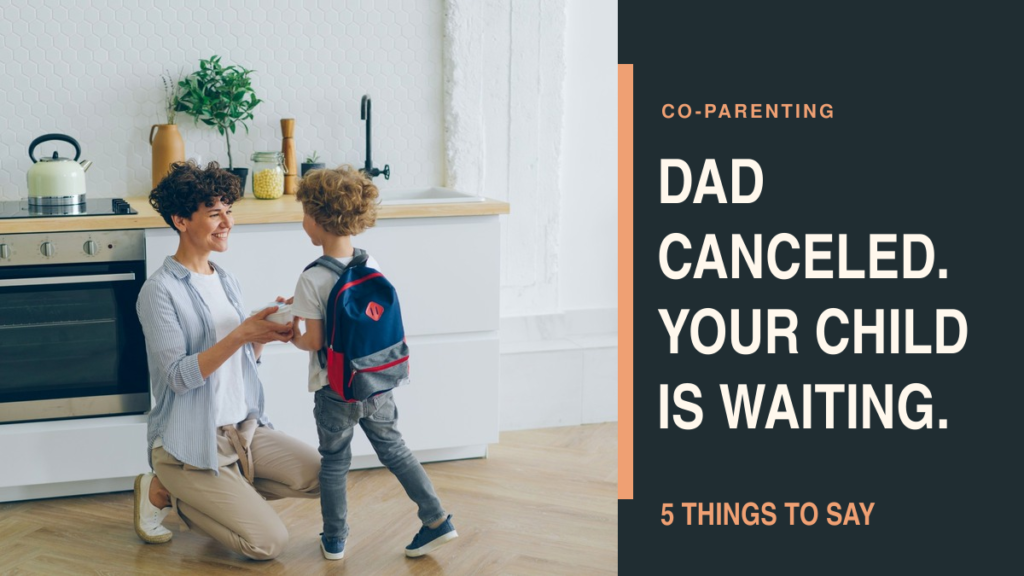
The shoes are on. The little backpack is by the door. Your child has already asked twice whether Dad is close.
Then your phone lights up: he cannot come. Perhaps he has an explanation; perhaps he only says, “Something came up.” You have an adult reaction to that message, but a child is standing in front of you with a smaller, sharper question: What happens now?
The first job is to give your child a true answer they can carry. You do not have to make the cancellation sound acceptable. You also do not have to tell the story of your entire relationship while your child is still holding their shoes.
First, say what you actually know
“Dad can’t come today. I know you were expecting him.” That is enough to start. If you have a confirmed new plan, you can say it. If you do not, “I don’t know when the next visit will be yet. I’ll tell you when I know” is more dependable than “I’m sure he’ll come tomorrow.”
There is a difference between protecting hope and manufacturing a promise. A child can be disappointed by a canceled plan and still feel steadier when the adult in front of them gives clear information. If Dad has not answered, say you have not heard back. Do not assign a motive you cannot know.
The American Academy of Pediatrics advises parents navigating separation to speak in simple terms, reassure children that the situation is not their fault, and keep children out of adult disputes. That guidance is especially useful at a doorway like this one. Read the AAP guidance on helping children adjust to separation.
Five things to say when Dad cancels

Photo: Kampus Production / PexelsThese are not lines you must recite perfectly. Choose the one that answers the question your child is asking. Then pause long enough to hear what comes back.
1. When the child is still expecting him
“The plan changed. Dad isn’t coming today. I know you were ready, and it makes sense to feel upset.”
This names the event without asking your child to agree that it is fine. A preschooler may need the concrete version: “We are staying here today. You can take your shoes off if you want.” An older child might want to know exactly when you found out. Answer what you can, without offering the texts as evidence for a case against the other parent.
2. When they ask, “Was it because of me?”
“No. You did not cause the change. Grown-ups are responsible for making and changing grown-up plans.”
Do not make the reassurance conditional on how well your child behaved this week. They should not have to be extra cheerful, quiet, or easy to love in order to get a visit. If they ask again tomorrow, answer again. A repeated question may be a request for the same reassurance, not proof that you said it badly the first time.
3. When they demand a reason you do not have
“I don’t know why he couldn’t make it. I won’t guess. I can ask him directly, and I’ll tell you what I know when there is a clear plan.”
If he provided a simple explanation that is appropriate to share, give it plainly: “He says he is sick.” You can say that without promising he will recover by a particular day. If the explanation changes or does not add up, your child does not need to become the investigator. Your job is to manage adult communication; theirs is to be a child.
4. When they say, “I’m never trusting him again”
“You sound really hurt. You don’t have to decide how you feel about Dad for the rest of your life today.”
Resist the urge to correct their anger with “He loves you, though.” Love may be something your child experiences, questions, or expresses differently from you. You can acknowledge the hurt without deciding the whole relationship for them. “You can be mad and still miss him” may be the truest sentence in the room.
5. When they ask what happens next
“Today we’ll make a plan for this afternoon. I’ll handle the grown-up conversation about the next visit. You don’t have to fix it.”
Offer a small choice that does not pretend to replace Dad: “Do you want to stay in for a bit or go to the park?” If your child wants to sit with the disappointment before doing anything, allow that too. The alternative activity is a way to take care of today, not a reward for hiding sadness.
The sentence you might want to say—and what it asks of your child
“He always does this” may be true to your experience. In that moment, however, it asks your child to take on an adult pattern while they are still processing one afternoon. “I can’t believe he did this to us” can make your child feel responsible for comforting you.
You deserve a place to say those sentences. Text a trusted adult, journal, or talk with a counselor out of your child’s hearing. The AAP specifically advises against making children messengers or putting them in the middle of conflict between parents. Its discussion of common traps for separated parents is worth reading before the next difficult exchange.
This does not require you to praise a parent who repeatedly disappoints a child. It means keeping your child’s feelings in the foreground while adult accountability stays in an adult conversation.
What to do with the rest of the day
Start by settling the practical question: Are you staying home? Is there a pickup to cancel? Does your child need to change clothes or tell a sibling the plan changed? Ordinary details matter because they make the situation understandable.
Next, ask one open question: “What part are you most upset about?” The answer might be the missed time with Dad, the canceled movie, or being embarrassed because they told a friend. You cannot solve each part in the same way. Listen before offering a fix.
Then keep the routine you can keep. Dinner, bedtime, homework, or a favorite evening show can provide familiar structure. AAP guidance notes the value of predictable daily routines during separation. That does not mean pretending nothing happened. You can make space for feelings and still serve dinner at dinner time.
If your child wants to call or message Dad, consider whether that is workable and appropriate in your circumstances. Make the adult arrangement yourself; do not hand the child your phone to negotiate a new visit. If contact is unsafe, restricted, or part of a difficult legal arrangement, follow your specific safety plan and seek qualified local advice rather than relying on a general article.
When this keeps happening
One cancellation needs a conversation. A pattern needs a more reliable system. Before announcing a visit to your child, you may decide to wait for confirmation at an agreed time. You may keep the day’s plans flexible until pickup is certain. These steps do not erase the other parent’s responsibility; they reduce how often your child has to wait at the door for an unconfirmed arrival.
Keep factual notes for yourself: date, planned time, when you learned the plan changed, and what was actually agreed next. Keep the log away from your child. It is a way to remember accurately when you speak to the other parent or a professional, not a scorecard for your child to read.
An adult message can be brief: “Please tell me by 6 p.m. the day before if Saturday’s pickup is happening. I need to give our child a plan I can stand behind.” If that request is ignored, you can adjust what you tell your child: “There might be a visit this weekend. We’ll know on Friday.”
If your child develops ongoing sleep problems, marked distress, school difficulties, or worries that do not ease, speak with their pediatrician or a qualified child mental health professional. The AAP notes that children react differently and that help is available when reactions become concerning. This article cannot assess your child’s particular situation.
A short answer for the doorway
If you remember nothing else, say: “Dad can’t come today. I know you were excited. It isn’t your fault. I’m here with you, and I’ll handle the next plan.” Then stop talking for a moment. Let your child ask, cry, shrug, or run to another room. You can be a steady adult without being a cheerful one.
FAQ: Should I tell my child the reason Dad gave?
Share a simple, confirmed, age-appropriate reason if it helps your child understand the change. You do not need to share accusations, financial disputes, screenshots, or private adult details. If you do not know the reason, say so. Honesty can be brief.
FAQ: What if my child says they do not want to see Dad next time?
Take the statement seriously as a feeling, not as a decision your child must make at the doorway. Ask what worries them and listen without arguing. Arrangements and safety questions depend on the family and any applicable agreements; a qualified local professional can help if the pattern is serious or your child feels unsafe.
Clearhearted publishes general educational content. It is not therapy, counselling, medical, or legal advice and cannot account for your specific situation. See our Disclaimer.

Conversation
Comments are closed.