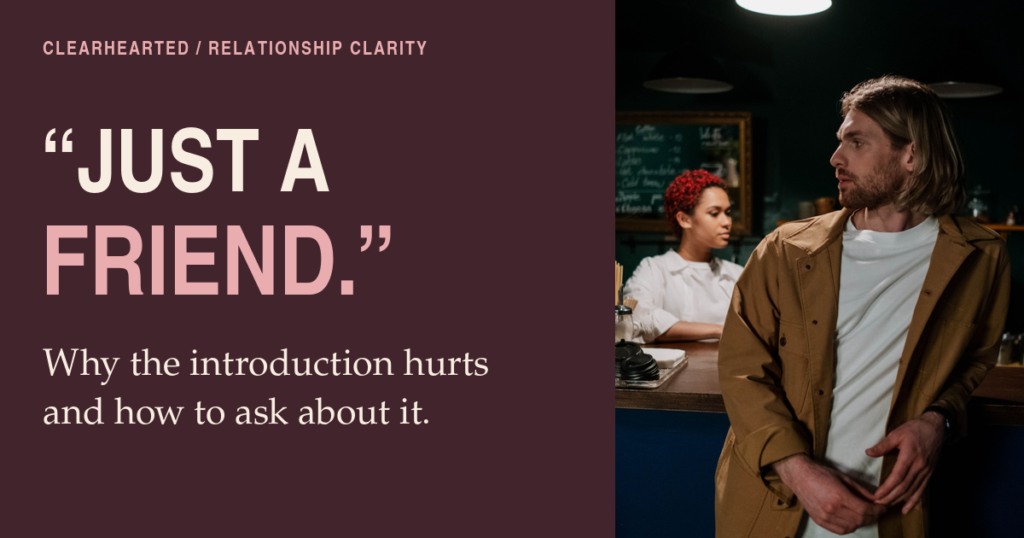
You have spent weekends together for months. You have met after work, helped him through a difficult week, and learned the coffee order he never gets right on his own. At a party, he gestures toward you and says, “This is my friend.”
You smile because there are six people listening. Later, the word keeps replaying. Did he mean to keep the relationship private? Was he nervous about labels? Does he see the two of you differently than you do?
The introduction may have an ordinary explanation. The sting is still worth discussing. You can ask what he meant without conducting a trial in front of his friends or deciding from one word that you know the whole story.
Start with what the two of you have actually agreed
“Friend” can be inaccurate for an exclusive relationship and entirely accurate for people who are dating casually without a shared label. Before you interpret the party, consider your conversations so far. Have you agreed to be partners? Are you exclusive? Have you talked about what you call each other in public?
If the answer is no, this may be the moment you discover that the ambiguity you could live with privately feels different when it is spoken aloud. That is useful information about your needs, even if he did not intend harm.
If you have explicitly agreed on a relationship, the introduction deserves a more direct question. Perhaps he misspoke, perhaps the person he was introducing you to needed a different explanation, or perhaps he is reluctant to acknowledge a commitment he makes in private. You cannot settle which one by studying his expression across the room. You can ask and observe what happens next.

Privacy and secrecy do not feel the same
Some couples prefer to keep their relationship off social media or wait before telling family. Those choices can be mutual and protective. A private relationship still has language the two people understand. You can say, “We are together, and we agreed not to announce it at work yet.”
Secrecy is harder to navigate when only one person knows the rule, or when the rule changes depending on who is watching. Perhaps you are his partner at home and “just a friend” around every person whose opinion matters to him. Perhaps he tells you that introducing you properly would make things awkward but cannot say what would change or when. The question becomes who benefits from the ambiguity and whether you consent to it.
There can be serious reasons for privacy, including family pressure, work boundaries, or safety concerns. Those deserve a careful conversation rather than an automatic accusation. If you are in a situation where public disclosure could put either person at risk, decide together what is safe and fair. The point is shared knowledge and choice.
Research on secret romantic relationships has found associations between secrecy and lower measures of relationship well-being. That does not mean every private relationship is harmful. The circumstances and whether both people freely chose privacy matter.
Ask about the introduction, not his hidden intentions
Wait until you can talk without an audience. State the event and the effect it had on you:
“At the party, you introduced me as your friend. I felt confused because I thought we were dating as partners. What did you mean by that?”
If you have not defined the relationship, try: “Hearing ‘friend’ made me realize I don’t know how you describe what we’re doing. How do you see us?” These questions give him space to explain and give you a chance to say what you want.
You can also be precise about the future: “If we’re going to keep dating, I would like us to agree on how we introduce each other.” The conversation need not end with an elaborate public announcement. It should end with more clarity than you had before it began.

Listen for clarity, not the most reassuring sentence
“You know you’re special to me” may be heartfelt. It does not answer what “friend” meant or how he plans to introduce you next time. You can appreciate the affection and return to the question: “I care about you too. Are we both comfortable calling this a relationship?”
A helpful answer might be, “I’m sorry. I panicked because I haven’t told my colleague we’re dating. I should have discussed that with you first. Can we decide what to say at work?” He names the context, takes responsibility for the surprise, and involves you in a plan.
An answer may also reveal a mismatch: “I like seeing you, but I don’t want to be in a relationship.” That can hurt, but it is clearer than an indefinite string of private affection and public vagueness. You get to decide whether continuing on those terms works for you.
Be careful with an explanation that moves every time you get close to it. One week he says his friends are too nosy; next month he says he hates labels; then he asks you not to tell a new person you are dating. The issue may no longer be a single awkward introduction. You are being asked to participate in a pattern you did not choose.
If public and private versions of your relationship have drifted apart, our article on feeling small around someone everyone else admires explores another way the outside picture can differ from your experience.
A label cannot do the work of a relationship
It is possible to receive the title you want and still feel unseen. Someone can introduce you as “my girlfriend” and make no time for you, refuse important conversations, or ignore your boundaries. Equally, a new couple may not have chosen a label but treat each other with care and honesty.
So consider both the word and the behavior around it. Are you invited into parts of his life in a way that fits the relationship you have discussed? Does he tell you when a setting calls for privacy, instead of making the decision for you in front of other people? When you explain how the introduction felt, is he willing to talk rather than making you feel foolish for noticing?
You do not need every friend, colleague, and relative to know your story. You do need to know the story the two of you believe you are in.

Before the next gathering
If you decide to keep seeing each other, agree on one practical sentence. It could be “This is my partner,” “We’ve been dating,” or another description you both endorse. If there is a setting where you want privacy, agree on that exception together before you walk into the room.
Then observe the next ordinary introduction. You should not have to monitor every word for proof of devotion. You are looking for whether the conversation changed anything and whether your view was included.
Is “friend” always a red flag?
No. A single word can reflect a slip, an unclear agreement, or a privacy concern. Ask in context. Repeatedly denying a relationship you have both defined is a different issue.
What if I am not sure what label I want?
You can say that. “I don’t know what to call us yet, but I don’t want to be surprised by an introduction.” You can agree on a temporary description while continuing the larger conversation.
What if he refuses to discuss it?
You cannot make him choose a label. You can decide whether being kept uncertain works for you. If the refusal comes with ridicule or pressure to hide, consider speaking with a trusted person about the broader relationship, not only the word at the party.
The introduction lasted a few seconds. The conversation afterward can tell you much more about whether the two of you are making room for the same relationship.
Clearhearted publishes general educational content about relationships. It is not therapy, counselling, or medical advice, and it cannot account for your specific situation. See our Disclaimer.