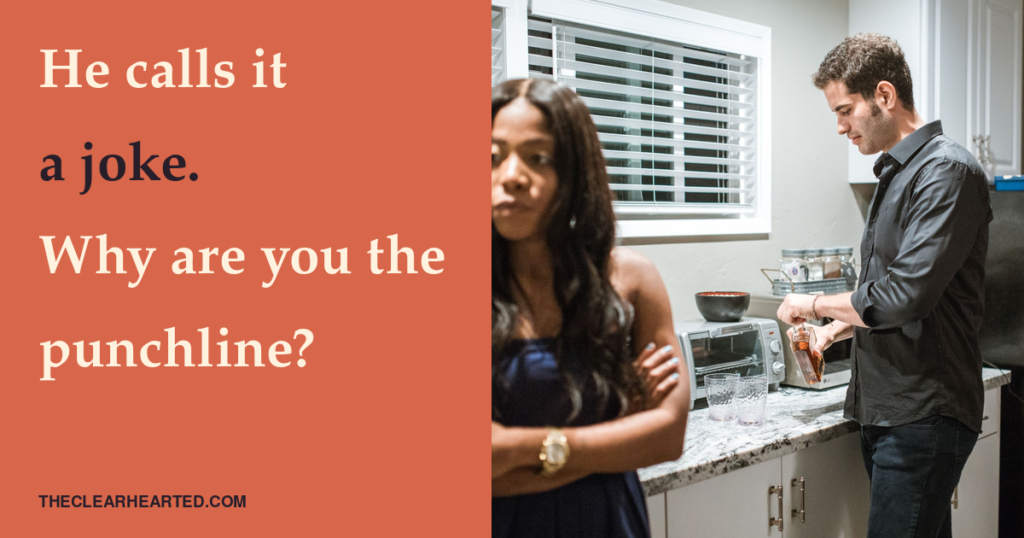
You are at dinner with friends when he tells a story about the time you got lost. Everyone laughs. You laugh too, partly because the story is funny and partly because correcting it would make the table go quiet.
On the way home, you tell him you did not like the part where he called you helpless. He says you are making a harmless joke into a problem. The next time you are out, he tells another version. Different story, same role for you.
The question is not whether couples are allowed to tease each other. Of course they are. The question is whether you get to say which stories about you are yours to share—and whether your discomfort changes anything.
The difference between a joke and a pattern
One clumsy joke can be repaired. He notices your face, asks what landed badly, and leaves that material alone next time. You do not need to establish malicious intent for the impact to matter.
A pattern looks different. The jokes repeatedly target your intelligence, appearance, family, work, money, or something you confided privately. They appear in front of people whose opinion matters to you. When you object, the conversation turns to your alleged inability to take a joke rather than his choice to repeat it.
Context also matters. You may both enjoy private, mutually agreed teasing that would feel humiliating at a family dinner. What was funny in one setting can be exposing in another. The standard is not “Would a stranger laugh?” It is “Can each of us say stop and be heard?”
Notice the role the joke gives you
Humor can make a point without making a person smaller. “We got lost and found an amazing bakery” invites you into the story. “She cannot even read a map” makes you the defective character in it.
Ask yourself three concrete questions. Does the joke reveal something you shared in confidence? Does it leave other people with a picture of you that you have to correct later? When you make a joke about him in the same way, is it still “only a joke,” or does he suddenly understand why words matter?
This is not a scoring system. It helps you see whether the humor is reciprocal and welcome, or whether you have learned to laugh to keep the peace.
What to say in the moment
You can keep it short: “Leave that one out.” Or: “I do not want that story told about me.” If the room is already listening, you may prefer: “That is not how I would tell it,” and return to the larger conversation. You are not required to give a speech for your preference to count.
Later, be specific about the exact joke and the boundary: “When you called me helpless in front of your friends, I felt embarrassed. Please do not make my competence the punchline again.” That sentence is more useful than “Stop disrespecting me,” because it names an observable change.
If he says, “So I can never joke around you?” you can answer the real question: “We can joke. I am asking you not to use that subject.” You do not have to defend the entire concept of humor.
How to read his response
A good response does not have to sound polished. He may say, “I did not realize that landed that way.” What matters is whether the particular joke stops. A brief awkward conversation followed by changed behavior is a workable outcome.
A more concerning response is the recurring trial of your sensitivity: he debates whether you are objectively allowed to feel hurt, asks others to vote, or repeats the joke with a new audience. Now the issue extends beyond humor. He knows what you asked and keeps making you pay for asking.
An apology also needs a next chapter. If he apologizes in private and performs the same joke in public, look at the repeated choice rather than the private speech. Our article on apologies followed by the same behavior explores that gap.
When you have laughed along before
Maybe you laughed the first five times. That does not sign away your right to change your mind. You might say, “I know I laughed before. I was uncomfortable and did not say so. I am saying it now.”
Sometimes the hard part is admitting to yourself that you have been performing enjoyment. There is no shame in choosing an easy laugh at a crowded table. There is also no obligation to keep doing it because the audience expects it.
If you have started rehearsing how to avoid certain gatherings, or choosing clothes and stories based on what he might turn into material, pay attention to the cost beyond any single joke. The relationship should leave room for you to be a full person in public.
A small boundary you can actually measure
Choose one category that is off-limits—perhaps your work mistakes or a private family story. Tell him plainly, once, outside the heat of an argument. Then watch what happens at the next ordinary opportunity. Does he leave it alone? Does he catch himself and correct course? Or does he turn your boundary into the next punchline?
You cannot make someone find you funny in the same way you find yourself funny. You can decide whether you want to keep sharing a table with someone who makes your discomfort part of the entertainment.
If other people are in on the joke
It can feel especially hard to object once your friends have learned the routine. You do not have to persuade the whole group at once. Start with the person whose behavior you can address directly. If a friend repeats the story, you can say, “I know that version got a laugh, but I’d rather not be introduced that way.” A friend who cares about you can adjust without a public hearing.
You also get to make different decisions in different rooms. A quick correction at a party may be enough for that night; a private conversation with him may be necessary for the longer pattern. The fact that you did not confront it perfectly in front of an audience does not weaken the boundary.
If you find yourself avoiding people you otherwise like because you dread becoming the subject, that is important information about what the jokes are costing you. The loss is not only a few uncomfortable seconds. It may be your ease with the people around you.
Clearhearted publishes general educational relationship content. It is not therapy, counselling, medical, or legal advice and cannot account for your specific circumstances. See our Disclaimer.

Conversation
Comments are closed.